

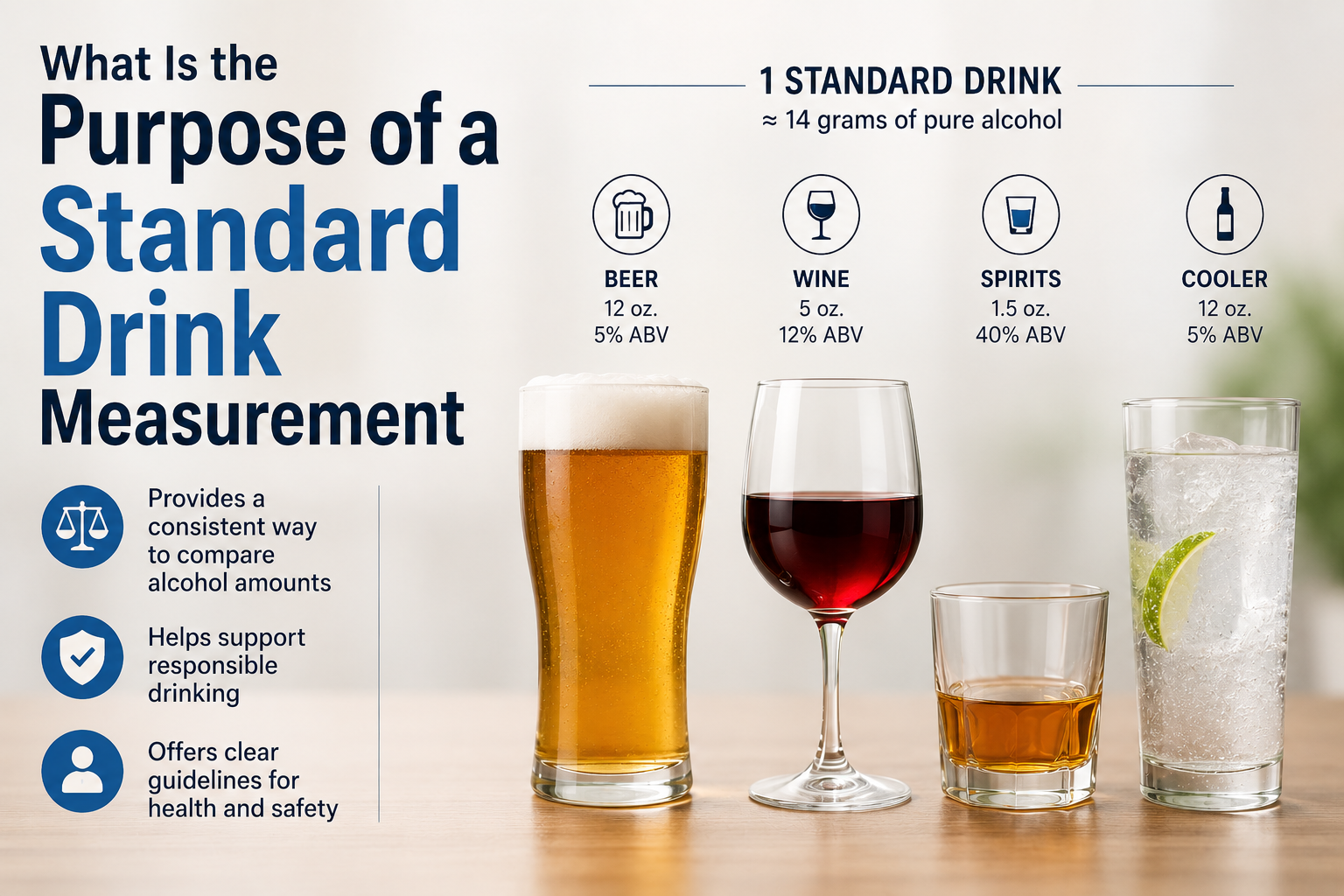
The purpose of a standard drink measurement is deceptively simple: it lets a 12-ounce beer, a 5-ounce glass of wine, and a 1.5-ounce shot of liquor all be compared on equal footing, because despite looking completely different, each contains roughly the same amount of pure alcohol, about 14 grams, or 0.6 fluid ounces. Without that common unit, every drinking guideline, every screening question at a doctor’s office, and every public health recommendation would have no consistent way to actually measure what they’re talking about.
It sounds like a minor technicality until you realize almost nobody’s actual pour matches it, which is exactly why this measurement exists in the first place, and why understanding it changes how you read every drinking guideline you’ll ever come across.
What One Standard Drink Actually Looks Like
| Beverage | Standard Serving | Alcohol Content |
| Regular beer | 12 fl oz | ~5% ABV |
| Table wine | 5 fl oz | ~12% ABV |
| Distilled spirits (80 proof) | 1.5 fl oz | ~40% ABV |
All three deliver approximately the same 14 grams of pure alcohol to your body. That equivalence, not the volume of liquid, is the entire point of the unit.
Why This Comparison Actually Matters
Every major drinking guideline you’ve ever seen, moderate drinking limits, binge drinking thresholds, weekly recommended maximums, is expressed in standard drinks, not in glasses, bottles, or rounds. If you don’t know what a standard drink actually contains, those numbers can’t tell you anything meaningful about your own habits. Someone could technically be within a “two drinks a day” guideline while pouring wine glasses that each hold two or three standard drinks worth of alcohol, without ever realizing the math doesn’t line up.
Why Your Actual Pour Almost Never Matches the Standard
| Real-World Drink | Typical Serving | Standard Drinks It Contains | Why the Gap Exists |
| Restaurant wine pour | 6 to 9 oz | 1.2 to 1.8 | Pours are typically larger than the 5 oz standard |
| Craft beer (IPA) | 16 oz can, ~7% ABV | About 1.9 | Higher ABV and larger can size both add up |
| Mixed cocktail | 8+ oz, multiple liquors | 2 to 3+ | Often contains more than one shot’s worth of spirits |
| Large margarita | 12+ oz | 3 or more | Combines higher-proof spirits with bigger glassware |
This is the practical reason the measurement matters: most people aren’t miscounting because they’re being dishonest, they’re miscounting because the drink in front of them was never actually one standard unit to begin with.
How This Unit Gets Used in Practice
- Moderate drinking guidelines: generally defined as up to 2 standard drinks per day for men, 1 for women
- Heavy drinking thresholds: 5 or more in a day, or 15 or more per week for men; 4 or more in a day, or 8 or more per week for women
- Binge drinking definition: enough standard drinks in about two hours to bring blood alcohol concentration to 0.08%, typically 5 for men, 4 for women
- Clinical screening tools: questionnaires used by doctors and treatment providers ask about standard drinks specifically, not vague terms like “a few”
- Personal tracking: apps and worksheets used in moderation or recovery programs rely on this same unit to make daily totals meaningful and comparable over time
How to Actually Count Your Own Drinks Accurately
- Check the ABV percentage on the bottle or can, this is the biggest variable most people skip.
- Use a liquid measuring cup for spirits at home rather than eyeballing a pour.
- Remember that a “glass of wine” at a restaurant is often 1.5 to 2 standard drinks, not one.
- For mixed drinks, count each shot of liquor separately rather than treating the whole cocktail as a single drink.
- Use NIAAA’s Rethinking Drinking calculator if you want an exact count for an unusual container or ABV.
- Track your actual total over a week, not just a typical night, patterns are often clearer at that scale.
Why This Number Matters Beyond Just Curiosity
Accurately counting standard drinks isn’t just trivia, it’s often literally the first concrete step in recognizing a drinking pattern that’s become a problem. Someone who has always described their drinking as “a couple of glasses of wine” may be genuinely surprised to learn that habit translates to 4 to 6 standard drinks most nights, a number that reads very differently once it’s actually counted correctly.
If counting your own drinking this way is bringing up more concern than you expected, that’s worth taking seriously rather than brushing aside. Conway Behavioral Health provides treatment for alcohol use at multiple levels of care, and an honest standard-drink count is often exactly the kind of information that helps a provider understand where you’re actually starting from.
A Couple of Things Worth Clarifying
A “drink” is not a fixed container size. It’s a fixed amount of alcohol, which is exactly why a small, strong pour and a large, weak one can both equal one standard drink, or wildly different amounts, depending on what’s actually in the glass.
Light beer isn’t dramatically lower in alcohol than regular beer. Many light beers contain around 85% as much alcohol as regular beer, not the roughly half most people assume.
Current guidance increasingly emphasizes that there’s no fully “safe” drinking threshold, even moderate levels carry some measurable health risk, which is a shift from how these guidelines were framed in the past.
Bottom Line
A standard drink measurement exists to put wildly different beverages, a beer, a glass of wine, a shot of liquor, on the same scale, so that drinking guidelines, screening tools, and personal tracking all mean the same thing regardless of what’s actually being poured. Because real-world servings rarely match the standard, especially wine pours, craft beer, and mixed drinks, most people underestimate their actual intake without realizing it. Learning to count accurately is a small habit with an outsized payoff: it’s often the first moment someone gets an honest, comparable picture of their own drinking.
Common Questions About Standard Drink Measurements
Why isn’t a standard drink just based on the size of the glass?
Because alcohol content varies enormously between beverage types and even within the same type, glass size alone tells you nothing about how much actual alcohol you’re consuming.
How much alcohol is actually in one standard drink?
About 14 grams, or 0.6 fluid ounces, of pure alcohol, regardless of whether it comes from beer, wine, or spirits.
Why do most people underestimate how many standard drinks they’ve had?
Because real-world pours, restaurant wine glasses, craft beer cans, mixed cocktails, are typically larger or stronger than the standard reference amount.
Does this measurement apply the same way internationally?
No, other countries define a standard drink differently, some use 10 grams of alcohol as their unit, so guidelines don’t always translate directly across borders.
Is a light beer meaningfully lower in standard drinks than regular beer?
Not as much as most people assume, many light beers contain around 85% of the alcohol found in regular beer, not roughly half.
Can I use this measurement to figure out if my drinking is a problem?
It’s a useful starting point for an honest count, but a broader conversation with a doctor or treatment provider is the better way to assess whether a pattern needs attention.
Where can I find an accurate calculator for unusual drinks?
NIAAA’s Rethinking Drinking website offers a calculator that converts specific container sizes and ABV percentages into standard drink counts.
Do standard drink guidelines mean any amount of alcohol is completely safe?
No, current public health guidance increasingly notes there’s no fully risk-free level of drinking, even amounts often described as moderate carry some measurable health risk.