

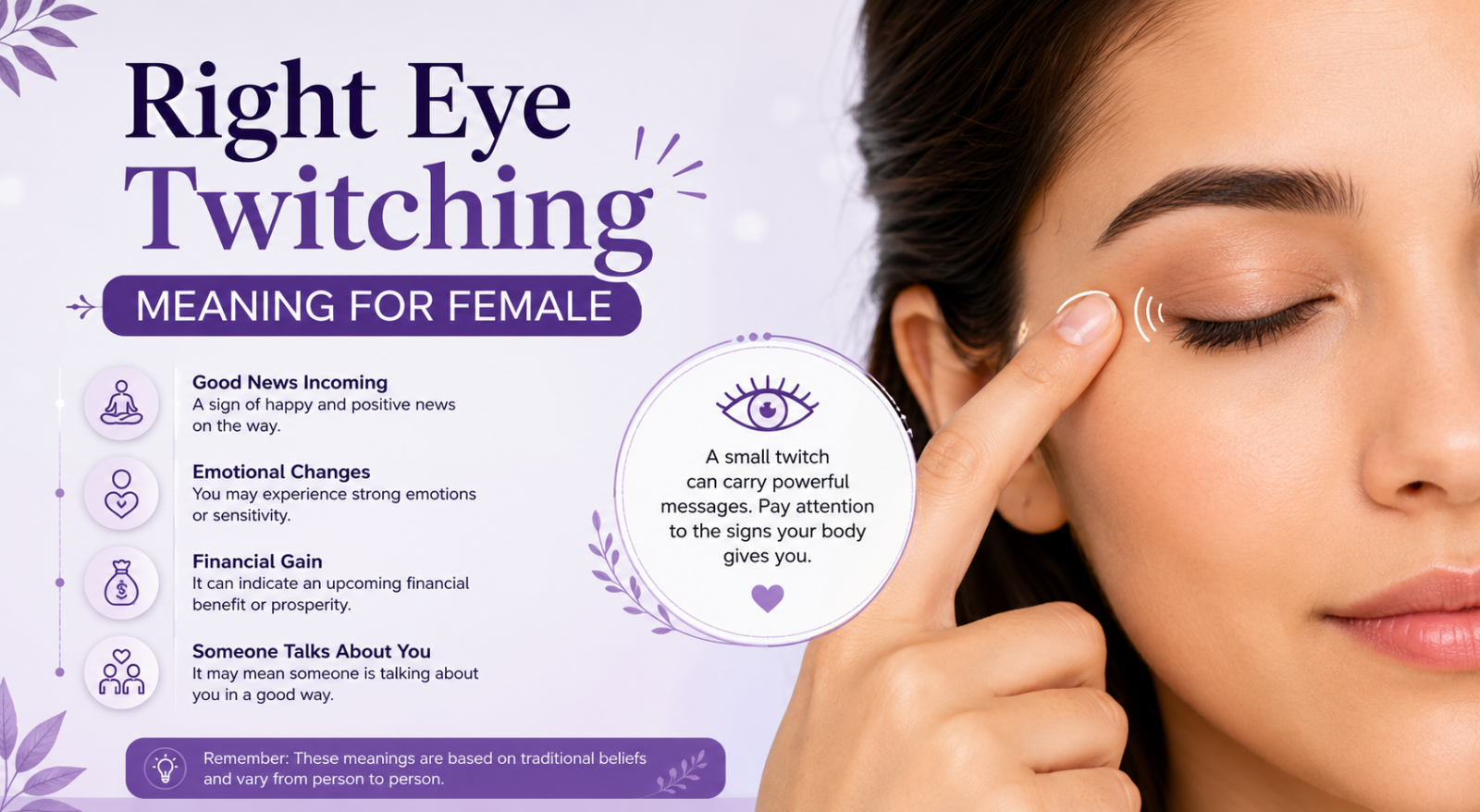
Searches for right eye twitching meaning for female are really asking two different questions at once: what does folklore say this means, and what does medicine say is actually happening. Folklore doesn’t have a single answer, different cultures have long assigned completely opposite meanings to a right eye twitch in women, which is itself a clue that it’s cultural belief rather than anything measurable. Medicine, on the other hand, has a pretty consistent, well-documented explanation, and it has nothing to do with luck.
Here’s both sides, starting briefly with the folklore since that’s clearly part of what brought you here, then the actual physiology, which is the part worth acting on if the twitching is persistent or bothersome.
What Different Traditions Have Said About It
None of the following is medically validated, it’s presented here as cultural context, not guidance:
| Tradition | Right Eye, Female | General Theme |
| Indian folk belief | Often considered inauspicious or a sign of upcoming worry | Right side meanings are frequently reversed between men and women |
| Chinese folk belief | Varies by region and time of day it occurs | Some regional traditions tie meaning to specific hours |
| African folk traditions (varies by region) | Sometimes linked to receiving unexpected news | Often framed as anticipatory rather than good or bad |
| Western superstition | Less codified, often just ‘someone is thinking of you’ | Generally treated as lighthearted rather than serious belief |
Worth noting: these meanings are frequently inverted for men versus women within the same tradition, and even contradict each other between neighboring regions. That inconsistency is a pretty strong sign this is cultural storytelling, not a documented pattern.
What’s Actually Causing It, Medically Speaking
The clinical term is eyelid myokymia, small, involuntary contractions of the orbicularis oculi, the muscle that closes your eyelid. It happens when the facial nerve controlling that muscle becomes temporarily overstimulated. This affects the right eye specifically just as often as the left, there’s no physiological reason it would target one side based on sex, it’s simply which eye you happen to notice it in.
The Actual, Documented Triggers
| Trigger | Why It Happens |
| Stress and anxiety | Emotional strain overstimulates the facial nerve controlling eyelid muscles |
| Fatigue or poor sleep | Tired nerves and muscles become more prone to involuntary firing |
| Caffeine or alcohol | Both overstimulate the nervous system generally |
| Extended screen time | Eye strain and reduced blinking fatigue the muscles around the eye |
| Dry eyes | Irritation triggers a reflexive protective twitch |
| Magnesium or electrolyte shifts | Debated in research, but commonly cited as a contributing factor |
Is There Actually Anything Different About This in Women?
There is one genuine pattern worth mentioning, separate from folklore: some research indicates eyelid myokymia is somewhat more commonly reported in middle-aged and older women, roughly in the 50 to 70 age range, though the exact reason for this isn’t fully settled. Hormonal fluctuations, which affect stress response and nervous system sensitivity more broadly, are one proposed factor, though this isn’t the same as saying twitching itself is a hormone-driven condition specific to women. For the vast majority of cases at any age, the standard triggers above, stress, fatigue, caffeine, screen time, explain it just as well in women as in men.
When This Stops Being Simple, Everyday Myokymia
- Twitching that lasts continuously for more than a week or two without easing
- Spreads beyond the eyelid to other parts of the face
- Causes the eye to fully close involuntarily, rather than a subtle flutter
- Comes with drooping, vision changes, or noticeable weakness on one side of the face
- Occurs alongside other new, unexplained facial or neurological symptoms
These patterns can point toward conditions like benign essential blepharospasm or, rarely, hemifacial spasm, both of which are still generally not dangerous but do warrant an evaluation from an eye doctor or neurologist rather than home management.
What Actually Makes It Stop
- Cut back on caffeine and alcohol for a few days and see if frequency drops.
- Prioritize consistent, adequate sleep, this is one of the most reliably effective fixes.
- Use artificial tears if screen time or dryness seems to be a factor.
- Take regular screen breaks using something like the 20-20-20 rule, every 20 minutes, look at something 20 feet away for 20 seconds.
- Address the underlying stress directly rather than only managing the physical symptom.
- See an eye doctor if it persists beyond two to three weeks despite these changes.
If Stress Is the Actual Root Cause
Since stress and anxiety sit at the top of the list of documented triggers, an eye twitch that flares up during busy, high-pressure stretches and eases once things calm down is telling you something fairly directly: your nervous system is running hot. Reducing caffeine and sleeping more can help around the edges, but if the underlying stress or anxiety itself is chronic and significant, treating the physical symptom alone tends to be a short-term patch.
If stress or anxiety feels like an ongoing weight rather than an occasional rough patch, that’s worth addressing directly rather than just waiting for the twitch to pass. Conway Behavioral Health provides treatment specifically for anxiety and stress-related conditions, which is often the more effective fix when a physical symptom like this keeps tracing back to how overloaded you’re feeling day to day.
A Couple of Things Worth Setting Straight
There’s no scientific basis for eye twitching predicting future events, good or bad. The folklore traditions above are culturally meaningful to many people, but they’re not a diagnostic tool.
A twitch doesn’t mean something is medically wrong with your eye itself in the vast majority of cases. It’s a nerve and muscle response to lifestyle factors, not a sign of eye disease.
Sex doesn’t determine which eye twitches or what it means physiologically. Any age- or sex-related patterns in the research are about frequency of reporting, not a fundamentally different mechanism.
Bottom Line
Culturally, a right eye twitch in women carries different, often contradictory meanings depending on which tradition you ask, which is part of why it’s worth taking as folklore rather than fact. Medically, it’s almost always eyelid myokymia, a benign, temporary nerve response most often triggered by stress, fatigue, caffeine, or screen time, and it affects women and men through the same mechanism. Persistent twitching lasting more than a couple of weeks, or accompanied by other facial symptoms, is the actual signal worth acting on, not which eye it happens to be.
Common Questions About Right Eye Twitching
Does a right eye twitch mean something different than a left eye twitch?
Medically, no, the same nerve and muscle mechanism applies to either eye. Any different meanings assigned to left versus right come from cultural folklore, not physiology.
Can hormonal changes cause eye twitching in women?
It’s a proposed contributing factor in some research, particularly around perimenopause, though stress, fatigue, and caffeine remain the most consistently documented triggers regardless of hormonal status.
How long is it normal for an eye twitch to last?
Most episodes resolve within a few days to about a week. Twitching persisting beyond two to three weeks is worth mentioning to an eye doctor.
Can dehydration cause eye twitching?
It’s often mentioned alongside electrolyte and magnesium factors, though the connection is less firmly established in research than stress, fatigue, or caffeine.
Is eye twitching a sign of a neurological problem?
Rarely. Most twitching is simple myokymia with no connection to neurological disease, though persistent, spreading, or unusual patterns should be evaluated to rule out less common conditions.
Should I see a doctor for occasional eye twitching?
Not usually necessary for brief, occasional twitching, but persistent or worsening episodes, or ones with additional facial symptoms, are worth an evaluation.
Can quitting caffeine actually stop eye twitching?
For many people, yes, reducing caffeine is one of the more reliably effective changes people report for reducing twitching frequency.
Is there any truth at all to the superstition side of this?
Not in a scientifically measurable sense, though it remains a meaningful part of cultural tradition for many people, separate from what’s actually happening physiologically.