

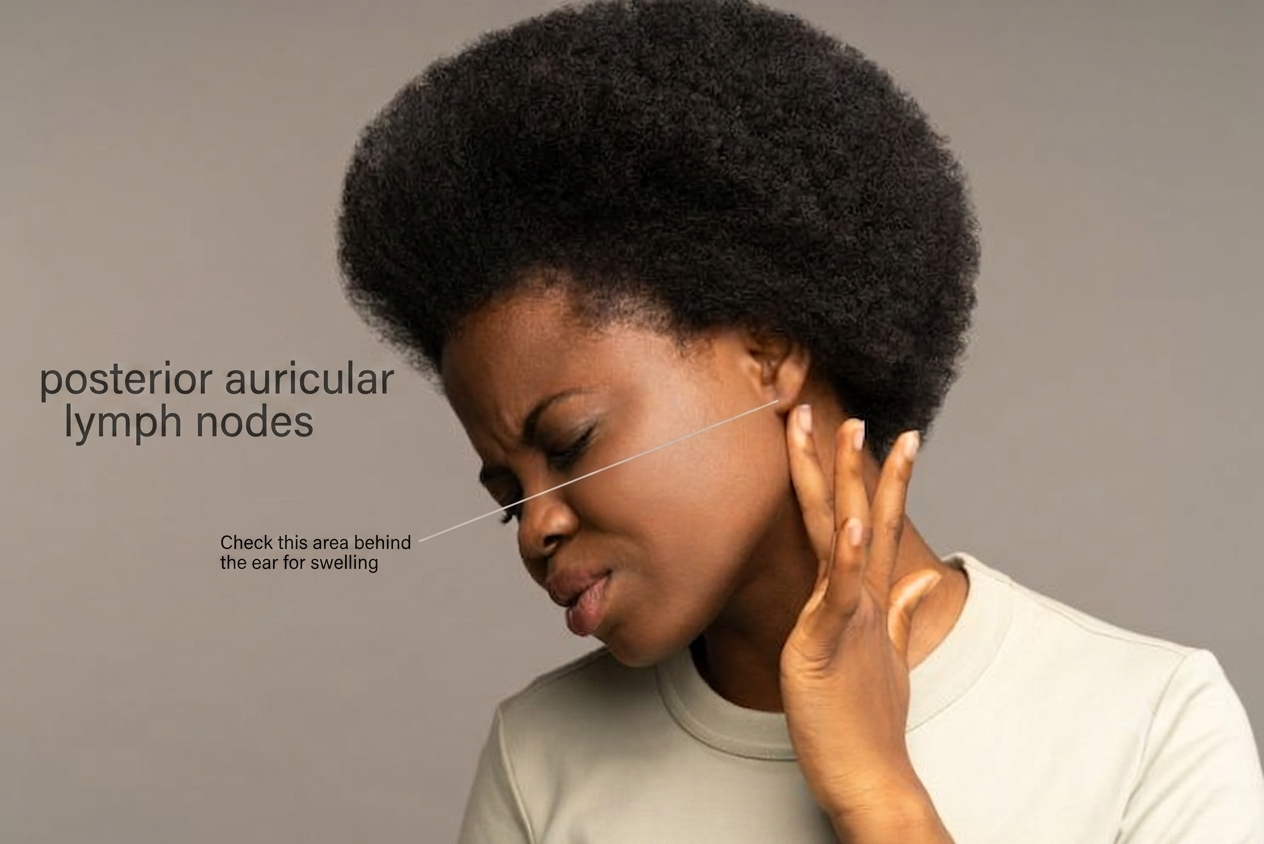
The posterior auricular lymph nodes sit just behind each ear, right around the bony bump you can feel behind your earlobe, called the mastoid process. They’re small, usually well under a centimeter, and under normal conditions you probably can’t feel them at all. Most people only discover they exist once one of them swells up enough to notice.
That discovery moment is usually what brings people to a page like this one. Here’s what these nodes actually do, why they swell, and how to figure out whether what you’re feeling is routine or worth a closer look.
What This Particular Set of Lymph Nodes Is Actually For
Posterior auricular nodes are part of a much larger network of several hundred lymph nodes throughout the body, this specific cluster drains lymphatic fluid from the scalp, the back of the ear, and the upper neck. As that fluid passes through, immune cells stationed inside the node screen it for bacteria, viruses, and other material that shouldn’t be there. When they find something, the node ramps up activity and grows temporarily, which is what you feel as swelling.
What Typically Causes Them to Swell
| Cause Category | Examples | How It Usually Presents |
| Scalp conditions | Seborrheic dermatitis, fungal infection, dandruff, lice | Often paired with visible scalp irritation or itching |
| Ear infections | Otitis externa (swimmer’s ear), otitis media | Ear pain, sometimes drainage or hearing changes |
| Viral illness | Common cold, mononucleosis, rubella | Often multiple swollen nodes, fatigue, sometimes fever |
| Skin infections nearby | Scalp cuts, insect bites, localized bacterial infection | Swelling typically on the same side as the skin issue |
| Dental or throat infections | Tooth abscess, strep throat | Node swelling alongside more prominent neck node involvement |
| Rare, more serious causes | Lymphoma, other malignancies | Painless, hard, fixed node that doesn’t resolve over weeks |
How Worried Should You Actually Be?
The overwhelming majority of swollen posterior auricular nodes trace back to something ordinary and temporary, a cold, a scalp irritation, an ear infection, that resolves on its own or with simple treatment within a couple of weeks. The rare, more serious causes exist, which is why doctors don’t dismiss persistent swelling out of hand, but they represent a small fraction of cases overall. The practical skill here isn’t memorizing every possible cause, it’s learning to recognize the handful of features that shift a swollen node from ‘probably nothing’ to ‘worth getting checked.’
Reassuring Features vs Ones That Warrant a Closer Look
| Usually Reassuring | Worth a Doctor’s Visit |
| Soft, movable when you press on it | Hard, fixed in place, doesn’t move under the skin |
| Tender or painful to touch | Painless, especially if it’s also hard and growing |
| Appeared alongside a cold, ear issue, or scalp irritation | No obvious trigger or accompanying illness |
| Shrinks over 1 to 2 weeks | Persists or keeps growing beyond 2 to 4 weeks |
| Just one node, one side | Multiple enlarged nodes in different areas, or accompanied by unexplained weight loss, night sweats, or persistent fatigue |
How to Actually Check One at Home
- Use your fingertips to gently feel behind the ear, along the bony ridge at the base of the skull.
- Note the size, roughly, most reactive nodes are pea to bean-sized, rarely larger than a grape.
- Check whether it moves slightly under light pressure, or feels fixed to deeper tissue.
- Note tenderness, painful nodes are more often reactive to a nearby infection than a red flag on their own.
- Check the opposite side for comparison, and check other common areas, neck, under the jaw, since multiple swollen nodes point toward a more systemic cause.
- Track how it changes over one to two weeks rather than checking obsessively multiple times a day.
What Treatment Actually Looks Like
Treatment targets the underlying cause, not the node itself, since the swelling is a downstream effect, not the problem in its own right. A scalp fungal infection gets an antifungal treatment, a bacterial ear infection gets antibiotics, a viral illness typically just needs time and supportive care. Warm compresses, adequate hydration, and rest can ease discomfort while the underlying issue resolves. If a doctor suspects something beyond a routine infection, next steps might include bloodwork, and in select cases, imaging or a biopsy to look more closely at the node itself.
When Checking Becomes Checking Too Much
Discovering a lump you never knew you had can trigger a specific kind of spiral: pressing on it repeatedly, comparing it to the other side every hour, searching your symptoms late at night. This is an extremely common reaction, not a personal failing, health-related worry tends to fixate hardest on things we can physically feel, like a node behind the ear, more than things we can’t.
If this kind of health-focused worry is a recurring pattern for you, not just limited to this one lump, but something that shows up around other symptoms too, it may be worth talking to someone about the anxiety itself alongside whatever your doctor finds medically. Conway Behavioral Health treats anxiety at multiple levels of care, and persistent health anxiety is a legitimate, treatable pattern, not something you’re expected to just push through alone.
A Few Things Worth Clarifying
A swollen lymph node behind the ear is not, on its own, a sign of cancer. The overwhelming majority are reactive responses to a nearby, usually minor, infection.
Pressing on a swollen node repeatedly doesn’t make it worse medically, but it also won’t speed up resolution, and can increase anxiety by keeping constant tabs on something your body is already handling.
Size alone isn’t the deciding factor. A larger but soft, tender, movable node following a cold is generally less concerning than a smaller but hard, painless, immovable one with no clear trigger.
Bottom Line
Posterior auricular lymph nodes are a normal part of your immune system, tasked with filtering fluid from the scalp and ear region, and swelling here is almost always a reactive, temporary response to a nearby infection or irritation. Most cases resolve within one to two weeks without needing anything beyond treating the underlying cause. Persistent, painless, hard, or rapidly growing nodes, especially without an obvious trigger, are the specific pattern worth a doctor’s evaluation, rather than something to lose sleep over on your own.
Common Questions About Posterior Auricular Lymph Nodes
Is it normal to be able to feel this lymph node all the time?
Not usually. Most people can’t feel these nodes at all when they’re not actively swollen, so noticing one is typically a sign of recent or ongoing reactive swelling.
How long does it typically take for a swollen node to go back down?
Most reactive swelling resolves within one to two weeks as the underlying infection clears, though it can occasionally take a bit longer.
Can stress alone cause this lymph node to swell?
Not directly, but chronic stress can weaken immune function, making infections that do cause swelling somewhat more likely.
Should I see a doctor even if the node isn’t painful?
Yes, especially if it’s painless and persistent, since painless, hard, or fixed nodes are one of the patterns doctors specifically want to evaluate.
Can children get swollen posterior auricular nodes too?
Yes, quite commonly, since children get frequent colds, ear infections, and scalp conditions that all commonly trigger this kind of reactive swelling.
Does an enlarged node in this location always mean an ear infection?
No, scalp conditions, viral illnesses, and other nearby infections can all cause it too, an ear infection is just one of several common triggers.
What tests might a doctor order if the swelling doesn’t go away?
Bloodwork is typically the first step, with imaging or a biopsy reserved for cases where initial findings or persistence raise more specific concern.
Is it safe to just wait and watch a swollen node for a couple of weeks?
Generally yes, if it’s soft, tender, and tied to an obvious recent illness, watching for one to two weeks before seeking care is a reasonable approach for most people.