

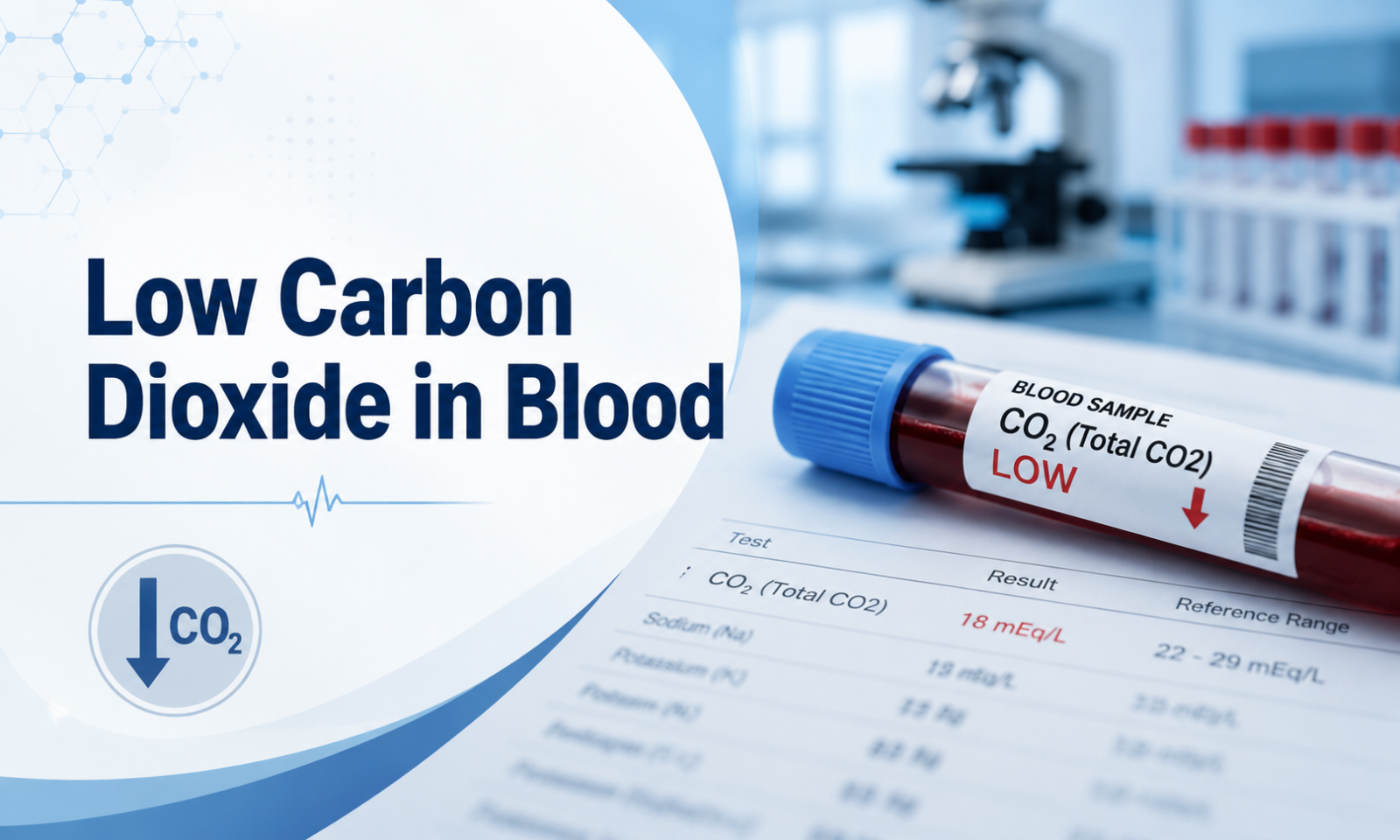
Seeing low carbon dioxide in blood flagged on lab results usually means one of two very different things is happening: either you’re breathing faster or deeper than your body needs (respiratory alkalosis), or your body is dealing with excess acid that’s using up bicarbonate to compensate (metabolic acidosis). These have almost nothing in common in terms of urgency or treatment, which is exactly why the same lab flag can mean ‘you had a panic attack’ for one person and ‘go to the ER’ for another.
Here’s how to tell which situation you’re actually looking at, starting with the numbers themselves.
What Counts as Low, Exactly
A standard metabolic panel typically reports CO2 (really a measure of bicarbonate) in a normal range of roughly 23 to 30 mEq/L. Values below about 20 mEq/L are generally considered notably low and worth a closer look at what’s driving them, though your lab’s specific reference range and your doctor’s interpretation of your overall picture matter more than the number in isolation.
The Two Categories of Causes, Side by Side
| Category | What’s Happening | Common Examples |
| Respiratory (hyperventilation-driven) | Breathing too fast or deep exhales too much CO2 | Anxiety and panic attacks, pain, fever, pregnancy, high altitude |
| Metabolic (acid buildup) | Body uses bicarbonate to buffer excess acid | Diabetic ketoacidosis, kidney failure, severe diarrhea, certain medications |
Notably, anxiety and panic attacks are consistently cited as the single most common trigger for the respiratory category, which is worth sitting with for a moment: a very large share of “why is my CO2 low” situations trace back to how someone was breathing in the hour or so before the blood draw, not an underlying disease process at all.
Why Fast Breathing Specifically Lowers This Number
Every breath you exhale removes some carbon dioxide. Breathe faster or deeper than your metabolism is actually producing CO2, and you clear out more than your body is generating, causing blood levels to drop. This shifts blood pH slightly upward (more alkaline), which is what doctors call respiratory alkalosis. Alkalosis then makes calcium behave differently around nerve cells, which is the actual mechanism behind that tingling, lightheaded, slightly unreal feeling that often accompanies a panic attack or anxiety spiral, it’s not just “in your head,” it’s a measurable chemical shift happening in real time.
What Low CO2 Actually Feels Like
- Lightheadedness or dizziness
- Tingling or numbness around the mouth, fingers, or toes
- A sense of not being able to get a full, satisfying breath
- Chest tightness
- Muscle cramping or brief spasms in more pronounced cases
- Difficulty concentrating or a foggy, detached feeling
When This Points Toward Something More Serious
Known diabetes with high blood sugar, fruity breath odor, nausea, or confusion: this combination raises concern for diabetic ketoacidosis, a medical emergency.
Known kidney disease with fatigue, swelling, or reduced urination: low CO2 here may reflect the kidneys’ reduced ability to regulate acid-base balance.
Severe or prolonged diarrhea: significant bicarbonate loss through the GI tract can lower CO2 independent of any breathing pattern.
A single episode tied to a clear anxiety or stress trigger that resolves within minutes to hours: this pattern is far more consistent with simple hyperventilation than a metabolic problem.
How Doctors Actually Sort Out Which One It Is
- A basic metabolic panel flags the low CO2 number itself, this is usually how it gets noticed in the first place.
- Blood pH testing (arterial blood gas) distinguishes respiratory alkalosis from metabolic acidosis, since the two cause opposite pH shifts despite both potentially lowering CO2 on certain panels.
- Additional labs, blood sugar, ketones, kidney function, help identify a specific metabolic cause if one is suspected.
- A symptom and timing history, was this tied to a panic episode, illness, or ongoing symptoms, often narrows things down before any further testing is even needed.
If Hyperventilation Is the Actual Cause, Here’s What Helps
- Slow, controlled breathing, extending the exhale longer than the inhale, helps CO2 levels normalize within minutes.
- Breathing into cupped hands (not a sealed paper bag, which can be genuinely risky) can help some people rebreathe a bit of exhaled CO2.
- Grounding techniques that interrupt a panic spiral, naming five things you see, four you can touch, and so on, can help slow breathing indirectly.
- If episodes are recurring rather than one-off, addressing the underlying anxiety directly tends to be more effective long-term than only managing each individual episode.
- See a doctor if you’re unsure whether an episode is anxiety-driven or something else, especially the first time this happens.
When the Pattern Keeps Repeating
A single hyperventilation episode during an unusually stressful day is common and generally nothing to build a bigger narrative around. A pattern of recurring episodes, especially if they’re starting to affect how you plan your day, avoid certain situations, or worry about the next one before it happens, is a different situation. That pattern has a name, and it’s treatable.
If low CO2 symptoms keep tracing back to anxiety or panic episodes rather than a one-time stressful event, that repetition is worth addressing directly rather than just managing each individual episode as it comes. Conway Behavioral Health treats anxiety and panic-related conditions at multiple levels of care, which is often the more durable fix compared to only responding to symptoms after they’ve already started.
A Few Things Worth Clarifying
Low CO2 doesn’t automatically mean a serious illness. In a large share of cases, especially isolated, symptom-tied episodes, it reflects a temporary breathing pattern rather than an underlying disease.
Breathing into a sealed paper bag is not the recommended fix it once was. It can dangerously reduce oxygen levels in some situations; cupped hands or simply slowing your breathing rate is the safer, currently recommended approach.
Feeling like you can’t get a full breath during hyperventilation doesn’t mean you need to breathe more, that instinct is exactly backwards and tends to worsen the underlying problem.
Bottom Line
Low carbon dioxide in the blood splits into two very different stories: a respiratory one, most often tied to anxiety-driven hyperventilation, or a metabolic one, tied to conditions like diabetic ketoacidosis, kidney disease, or significant fluid loss. The respiratory version is common, generally resolves quickly, and is closely linked to how someone is breathing in the moment, while the metabolic version needs a doctor’s evaluation and treatment of the underlying cause. Figuring out which category you’re in, largely through timing, accompanying symptoms, and a pH test, is what actually determines next steps, not the CO2 number by itself.
Common Questions About Low Blood CO2
Can anxiety alone cause low CO2 on a blood test?
Yes, anxiety-driven hyperventilation is one of the most common causes of temporarily low blood CO2, and it typically resolves once breathing normalizes.
How quickly does CO2 return to normal after a panic-related episode?
Often within minutes once breathing slows back to a normal rate, though it can take longer if hyperventilation was prolonged.
Is low CO2 always dangerous?
Not usually when tied to a brief anxiety-related episode, but low CO2 from an underlying metabolic condition can indicate something more serious that needs prompt evaluation.
What’s the difference between respiratory alkalosis and metabolic acidosis?
Both can involve low CO2, but they move blood pH in opposite directions and have entirely different underlying causes and treatments, which is why a pH test is important to distinguish them.
Should I go to the ER if my CO2 shows up low on a routine test?
Not necessarily, especially if it’s an isolated finding without concerning symptoms, but discuss it with your doctor, who can determine if further testing is needed.
Can chronic stress keep CO2 levels low over time, not just during acute episodes?
Yes, ongoing anxiety or habitual over-breathing patterns can maintain mildly low CO2 levels for extended periods, not just during isolated panic episodes.
Does high altitude affect blood CO2 levels?
Yes, increased breathing rate at high altitude to compensate for lower oxygen can also lower blood CO2, separate from any anxiety-related cause.
What should I do during a hyperventilation episode?
Focus on slowing your breathing and extending your exhale, use cupped hands rather than a sealed bag if that technique helps, and seek medical evaluation if it’s a new or unusual experience for you.