

Quick Answer
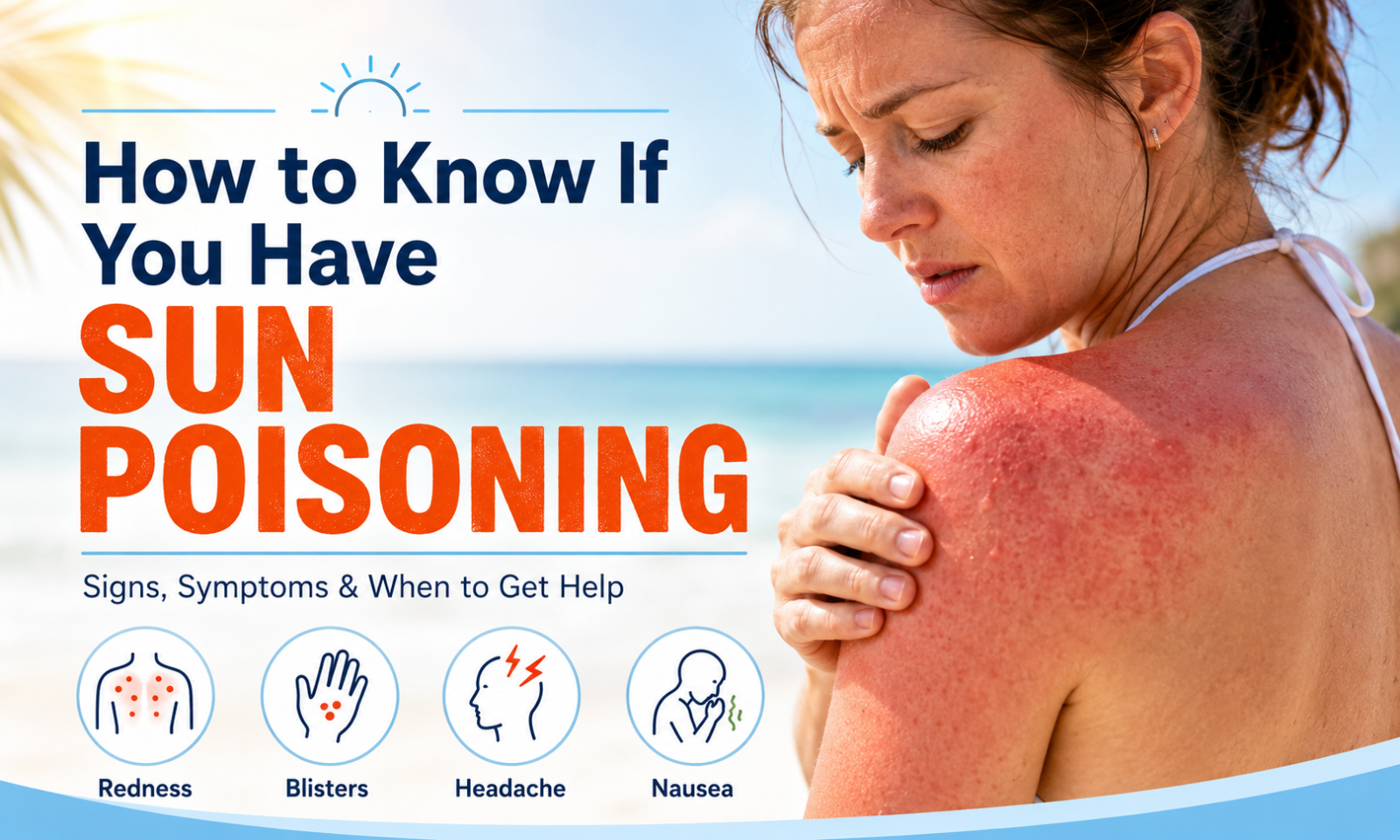
Sun poisoning is a severe sunburn that triggers whole-body symptoms beyond the skin: fever, chills, nausea, dizziness, and sometimes blistering. If you are wondering how to know if you have sun poisoning, the clearest signal is that your symptoms extend to your entire body, not just the areas that got burned. Mild cases can be managed at home with rest, fluids, and cooling. Cases involving high fever, vomiting, confusion, or blisters covering a large area need medical evaluation.
At a Glance
| Factor | Details |
| What It Is | Not a true medical diagnosis, a common term for a severe sunburn that produces systemic, whole-body symptoms |
| Key Distinguishing Feature | Symptoms go beyond the skin: fever, chills, nausea, headache, dizziness |
| When It Starts | Often looks like sunburn for the first 6 to 12 hours, then worsens |
| Who Is at Higher Risk | Fair-skinned people, those on photosensitive medications, high-altitude exposure, near reflective surfaces |
| Home Care Yes or No | Yes, for mild to moderate cases. No for high fever, vomiting, confusion, or large blisters. |
| When to Go to the ER | Confusion, fainting, difficulty breathing, rapid heartbeat, or inability to stay hydrated |
What Is Sun Poisoning and Is It Actually a Medical Condition?
Sun poisoning is not a formal medical diagnosis. It is a widely used term for a severe sunburn that has progressed beyond skin-level symptoms to trigger a systemic reaction throughout the body.
As Dr. Ashley Elsensohn, a dermatopathologist and Mohs surgeon at Loma Linda University Medical Center, explains, sun poisoning is likely a combination of the body’s response to a severe sunburn alongside overall dehydration. It is sometimes also linked to a photosensitivity reaction, where the skin is abnormally reactive to UV exposure because of medications, certain skin conditions, or genetic factors.
The name is misleading because there is no actual poison involved. What makes it serious is the extent of the reaction: when a sunburn is severe enough, the immune system responds systemically, and dehydration from prolonged heat and sun exposure compounds the effects.
What Are the Symptoms of Sun Poisoning?
Sun poisoning shares the skin-level symptoms of a bad sunburn: redness, pain, swelling, and sometimes blistering. The differentiating symptoms are the ones that involve the whole body, not just the skin.
| Skin Symptoms | Whole-Body Symptoms (the ones that matter most) |
| Severe redness and burning | Fever, often 101 F or higher |
| Painful swelling beyond the burned area | Chills that feel out of place given the heat |
| Blistering, especially widespread | Nausea or vomiting |
| Skin that feels hot to the touch even indoors | Headache, sometimes severe |
| Rash or raised welts in some cases | Dizziness or lightheadedness |
| Peeling that begins within days | Rapid heart rate |
| Extreme fatigue or weakness | |
| Confusion or difficulty focusing in severe cases |
Per dermatology sources including Schweiger Dermatology Group, the presence of whole-body symptoms is what distinguishes sun poisoning from sunburn, not blisters alone. You can have sun poisoning without significant blistering if the systemic symptoms are present.
How Do You Tell the Difference Between Sun Poisoning and a Bad Sunburn?
This is the question most people are actually trying to answer. The clearest test is simple: are your symptoms only on the burned skin, or are they affecting your whole body?
| Symptom or Feature | Sunburn | Sun Poisoning |
| Location of symptoms | Skin only, where the burn happened | Skin plus whole-body symptoms |
| Fever | No, or very mild | Yes, often 101 F or higher |
| Nausea or vomiting | No | Common |
| Chills | No | Yes, even in warm temperatures |
| Headache | Mild, if any | Can be significant |
| Dizziness | No | Yes |
| Blistering | Possible with severe sunburn | Common, often more widespread |
| Recovery time | 3 to 7 days | Several days to 2 weeks for full skin recovery |
| Need for medical care | Usually no | Sometimes yes, always for severe cases |
What Does Sun Poisoning Feel Like in the First Few Hours?
This is where it catches people off guard. According to Brown University Health, sun poisoning often presents identically to a sunburn for the first 6 to 12 hours.
You may come indoors feeling hot and burned, lie down, and assume you will feel better after some rest and water. The tell is when symptoms intensify rather than plateau: when chills set in despite not being cold, when a headache builds rather than fades, or when nausea starts several hours after sun exposure.
That escalation pattern, symptoms that worsen past the 6 to 12 hour mark rather than stabilizing, is one of the clearest signs that what you have is more than a typical sunburn.
Who Is Most at Risk for Sun Poisoning?
- People with fair skin and light eyes: less melanin means less natural UV protection, making severe burns more likely faster.
- Anyone on photosensitizing medications: certain antibiotics such as doxycycline, acne medications like isotretinoin, antidepressants, oral contraceptives, diuretics, and some diabetes medications can make skin dramatically more sensitive to UV exposure.
- People with lupus, psoriasis, or certain autoimmune conditions: these conditions can increase UV sensitivity.
- People at high altitude or near the equator: UV intensity increases at elevation and near the equator, meaning the same amount of time outdoors causes more damage.
- Anyone near reflective surfaces: water, snow, sand, and even pavement reflect UV rays upward, significantly amplifying exposure.
- People with a family history of skin cancer: this can also correlate with increased UV sensitivity.
Can You Get Sun Poisoning Even on a Cloudy Day?
Yes. Up to 80 percent of UV rays pass through cloud cover, according to the American Cancer Society. Overcast days create a false sense of safety that leads many people to skip sunscreen and spend long hours outdoors without realizing their exposure level.
Reflective surfaces like water and snow amplify this effect. A day on a boat under overcast skies can produce as much UV exposure as a clear beach day, sometimes more because the clouds make the heat less noticeable.
What Should You Do Right Away If You Think You Have Sun Poisoning?
- Get out of the sun immediately: into shade or indoors with air conditioning.
- Cool the skin, not aggressively: cool damp compresses or a cool shower, not ice or ice water, which can shock already stressed skin.
- Rehydrate with water and electrolytes: plain water is helpful but electrolyte drinks like Pedialyte, Gatorade, or a homemade salt and sugar solution replace what sweating depletes. Sip steadily rather than drinking large amounts at once if nausea is present.
- Take an OTC anti-inflammatory: ibuprofen reduces both inflammation and fever. Acetaminophen can help with pain and fever but does not address inflammation.
- Leave blisters alone: do not pop them. Blisters protect the damaged tissue underneath from infection.
- Avoid petroleum-based products or anything that traps heat: aloe vera gel or a light, fragrance-free moisturizer is appropriate. Products like Vaseline can trap heat in the skin and worsen burning.
- Monitor symptoms over the next several hours: improving means home care is working. Worsening means it is time to see a doctor.
When Does Sun Poisoning Require a Doctor or the ER?
Mild to moderate sun poisoning, meaning some nausea, a moderate headache, and general discomfort alongside the skin symptoms, can often be managed at home with the steps above.
These signs mean you need medical evaluation, not home care:
- High fever, particularly above 103 F
- Vomiting that prevents you from staying hydrated
- Confusion, disorientation, or difficulty speaking
- Fainting or loss of consciousness
- Rapid heartbeat or difficulty breathing
- Blisters covering a large portion of the body
- Swelling around the eyes or face
- Symptoms that persist beyond 48 hours without improvement
For severe dehydration, high fever with confusion, or any difficulty breathing, go directly to an emergency room rather than urgent care. Moderate symptoms without those emergency signs can be evaluated at urgent care or a same-day doctor’s appointment.
What Will a Doctor Actually Do for Sun Poisoning?
Treatment depends on how severe the case is. For moderate cases, a doctor may prescribe oral medications to reduce inflammation and manage pain. For significant dehydration or an inability to keep fluids down, intravenous fluids to restore hydration and electrolyte balance are the most common intervention.
If blisters have broken open and show signs of infection, antibiotics may be prescribed. Once the acute phase has resolved, a follow-up with a dermatologist is worth considering to assess any longer-term skin damage.
Do Certain Medications Make Sun Poisoning More Likely?
Yes, and this is one of the most underappreciated risk factors. Certain medications increase the skin’s photosensitivity, meaning it burns faster and more severely under the same sun exposure that would otherwise cause only mild redness.
Common categories include tetracycline-class antibiotics such as doxycycline, retinoids used for acne, certain antidepressants, thiazide diuretics, sulfonamide antibiotics, some antifungals, and oral contraceptives.
If you are taking any medication and are unsure whether it increases photosensitivity, check the package insert or ask your pharmacist before spending extended time outdoors.
How Long Does Sun Poisoning Take to Go Away?
The systemic symptoms, fever, chills, and nausea, typically improve within 24 to 48 hours with proper rest and hydration. The skin itself takes longer: redness and swelling usually improve over 3 to 5 days, while full skin recovery including any peeling can take up to 2 weeks.
The skin that was burned will remain more sensitive to sun exposure during recovery and for some time after. Additional sun exposure before healing is complete will extend the recovery significantly.
Is Sun Poisoning the Same as Heat Stroke?
No, though they can overlap. Sun poisoning is primarily a severe reaction to UV exposure and the systemic response it triggers. Heat stroke is caused by the body overheating to a dangerous internal temperature, usually above 104 F, and losing the ability to regulate its own temperature.
Both can occur at the same time in someone who spent many hours in extreme heat and sun without fluids. The distinguishing sign of heat stroke is the absence of sweating in a very hot body, confusion, and extremely high core temperature. Heat stroke is a medical emergency requiring immediate 911 contact.
What Most People Don’t Realize About Sun Poisoning
Most people assume blisters are the defining sign of sun poisoning. Dermatology sources are clear that this is not accurate. Systemic symptoms like fever, chills, and nausea can constitute sun poisoning even without significant blistering.
The more clinically significant detail is that sun poisoning in the short term carries long-term implications. Each severe sunburn measurably increases lifetime skin cancer risk. A study cited by GoodRx found that sunburns, including severe cases like sun poisoning, are associated with increased risk of cutaneous melanoma, and the risk accumulates with each episode.
Treating sun poisoning is important. Preventing the next one matters more.
How Do You Prevent Sun Poisoning From Happening Again?
- Apply SPF 30 or higher broad-spectrum sunscreen 15 minutes before going outside: broad spectrum means it blocks both UVA and UVB rays.
- Reapply every two hours and after swimming or sweating: most people under-apply and forget reapplication, which is where the protection fails.
- Avoid peak UV hours, 10 a.m. to 4 p.m., for extended outdoor activity: UV intensity is highest during this window.
- Wear UPF-rated clothing, a wide-brimmed hat, and UV-blocking sunglasses: clothing blocks UV rays more consistently than sunscreen on large body surface areas.
- Check medication photosensitivity warnings before outdoor plans: if your medication increases sun sensitivity, apply sunscreen more frequently and cover more skin.
- Hydrate before, during, and after sun exposure: dehydration worsens the severity of a sunburn and is a direct contributor to the systemic symptoms of sun poisoning.
The Three Question Check to Know What You Have
If you are trying to figure out what level of sun exposure reaction you are dealing with, three questions narrow it down:
- Are your symptoms only on the skin, or throughout your body? skin only points to a sunburn. Whole body points to sun poisoning.
- Are symptoms getting better or worse over the past six hours? improving means home care is working. Worsening means escalation to medical care is warranted.
- Can you stay hydrated, or is nausea or vomiting preventing it? if you cannot keep fluids down, that is an urgent care or ER situation regardless of other symptoms.
What Should You Do Right Now?
If you are currently experiencing fever, chills, nausea, or dizziness alongside sunburn symptoms, get out of the sun, start cooling and rehydrating, and monitor closely over the next few hours.
If symptoms are worsening rather than improving, or you cannot keep fluids down, do not wait to see a doctor. Urgent care is appropriate for moderate cases. Emergency care is appropriate for high fever with confusion, fainting, or difficulty breathing.
Avoid petroleum-based products on the burned skin, avoid popping blisters, and avoid further sun exposure until the skin has fully healed. That last point matters more than most people act on during recovery.
Suggested Internal Links
Add these once matching pages exist on your site, using descriptive anchor text:
- Link to a sunscreen guide using anchor text like “chooosing a broad spectrum sunscreen for high UV days”
- Link to a heat stroke symptoms guide using anchor text like “how to tell heat exhaustion from heat stroke”
- Link to a skin cancer risk guide using anchor text like “how repeated sunburns affect your long-term skin cancer risk”
External Sources
- GoodRx, Sun Poisoning vs. Sunburn: Symptoms, Treatment, Risks
- Cleveland Clinic, Sunburn vs. Sun Poisoning: How to Tell the Difference
Meta Details (SEO)
Meta Title: How to Know If You Have Sun Poisoning: Signs and Care
Meta Description: How to tell if you have sun poisoning vs a bad sunburn, what the whole-body symptoms are, and exactly when you need to see a doctor.
URL Slug: /how-to-know-if-you-have-sun-poisoning
Schema Type: Article with FAQPage markup for every question-headed section
Tags: sun poisoning symptoms, sun poisoning vs sunburn, severe sunburn treatment, when to see a doctor for sunburn, photosensitivity medications