

Typical starting doses, titration, kidney adjustments, side effects, and what the evidence says about nerve-root pain
| Dosage question | General guidance |
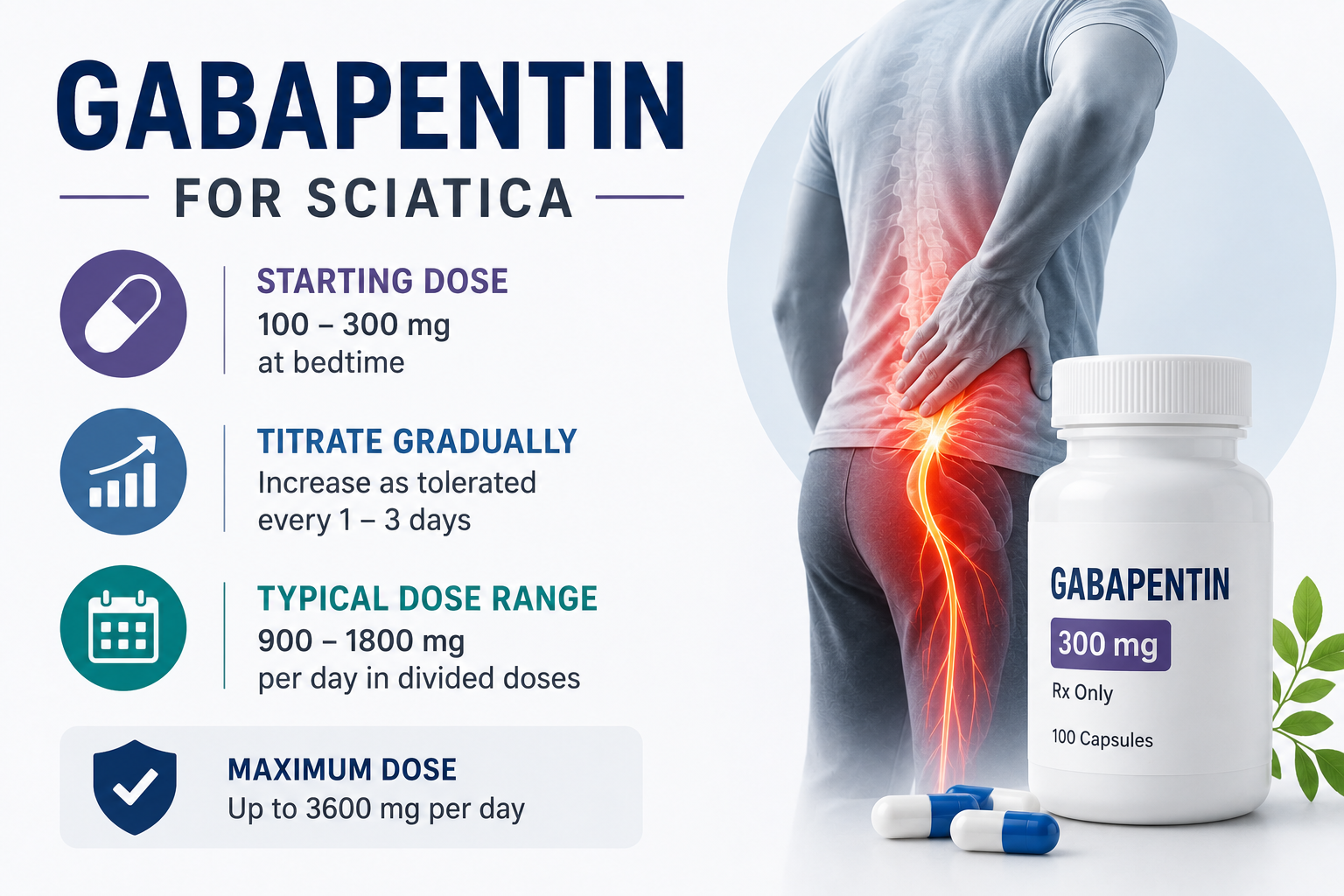
| Typical starting point | Many clinicians begin with 100 to 300 mg once daily, often at night, then increase gradually if needed and tolerated. |
| Common early schedule | A frequently used titration is 300 mg nightly, then 300 mg twice daily, then 300 mg three times daily. |
| Common nerve-pain range | About 900 to 3,600 mg per day in divided doses is used for neuropathic pain, but sciatica is an off-label use. |
| Maximum dose | 3,600 mg per day is a common upper limit for immediate-release gabapentin in adults with normal kidney function. |
| Kidney adjustment | Lower doses or longer intervals are required when kidney function is reduced. |
| Stopping treatment | Gabapentin should usually be tapered rather than stopped suddenly. |
Key Takeaways
- Gabapentin is not FDA-approved specifically for sciatica, so prescribing is individualized and off-label.
- A common starting dose is 100 to 300 mg once daily, with slow increases to reduce dizziness and sleepiness.
- Many nerve-pain regimens use 900 to 1,800 mg per day, while some patients receive up to 3,600 mg per day.
- Kidney function, age, other sedating medicines, and breathing conditions can substantially change the safe dose.
- Evidence that gabapentin helps sciatica is mixed, so continued treatment should depend on meaningful benefit.
The normal dosage of gabapentin for sciatica often begins at 300 mg once daily, usually in the evening, and may be increased gradually to 300 mg two or three times daily. Some adults with neuropathic pain use higher total doses, but there is no single correct dose for everyone, and a prescription should reflect kidney function, age, side effects, other medicines, and whether symptoms actually improve.
Gabapentin is used off-label for sciatica because the condition can cause burning, electric, tingling, or shooting pain from an irritated nerve root. It is less likely to help ordinary muscle soreness or mechanical low-back pain that does not travel down the leg.
What Dose Is Commonly Used?
A cautious plan usually starts low and increases in steps. This gives the body time to adjust and helps the prescriber identify the lowest dose that produces worthwhile pain relief without unacceptable drowsiness, dizziness, swelling, blurred vision, or poor coordination.
| Stage | Example dose | Why it is used | Important note |
| Starting dose | 100 to 300 mg once daily | Tests tolerability and may reduce nighttime symptoms | Older adults may start lower |
| Early titration | 300 mg twice daily | Adds daytime coverage | Increase only on the prescribed schedule |
| Common divided dose | 300 mg three times daily | Provides steadier exposure across the day | Space doses reasonably evenly |
| Higher-dose therapy | 600 mg three times daily or more | Sometimes used when lower doses fail | Requires closer review of benefit and side effects |
| Upper range | Up to 3,600 mg daily | Used in selected adults with normal kidney function | Not automatically better and not appropriate for everyone |
The reference article describes 300 mg once daily as a typical starting dose and notes that a clinician may increase it to three times daily. That is a starting framework, not a self-dosing instruction. Extended-release gabapentin products are not interchangeable with immediate-release capsules or tablets.
Why the Dose Must Be Individualized
Kidney Function
Gabapentin is removed mainly through the kidneys. When kidney function is reduced, the medicine can accumulate and increase sleepiness, confusion, unsteadiness, and breathing risk. A prescriber may lower the daily dose, lengthen the time between doses, or choose a different treatment.
The current FDA-approved gabapentin prescribing information includes kidney-based dose adjustments and warns about sedation and respiratory depression, particularly when gabapentin is combined with opioids or other central nervous system depressants.
Age and Fall Risk
Older adults may clear gabapentin more slowly and may be more sensitive to dizziness or imbalance. Starting at 100 mg or another low dose and increasing slowly may be appropriate, especially when the person already uses a cane, has fallen before, or takes blood-pressure or sleep medicines.
Other Medicines and Breathing Conditions
Opioids, benzodiazepines, sleeping pills, muscle relaxants, sedating antihistamines, alcohol, and some other medicines can intensify drowsiness or slow breathing. People with COPD, sleep apnea, or another respiratory disorder need additional caution.
| Never copy another person’s dose
A dose that is safe for one adult may be unsafe for someone with kidney disease, older age, respiratory illness, or interacting medicines. Use only the product and schedule written for you. |
Does Gabapentin Actually Help Sciatica?
The evidence is less reassuring than many patients expect. Gabapentin can be effective for certain neuropathic pain conditions, but studies of sciatica and lumbar radicular pain have produced inconsistent results. Some people report meaningful relief, while others experience side effects without enough improvement.
A useful trial should have a clear goal, such as better sleep, less burning leg pain, improved walking, or reduced need for another pain medicine. If there is no meaningful benefit after an adequate trial at a tolerated dose, the prescriber may taper it and consider other options.
Sciatica may also produce numbness, tingling, or weakness extending into the foot. Conway Behavioral Health’s guide to foot numbness and nerve-compression warning signs explains how a herniated disc or spinal stenosis can affect nerves traveling down the leg and when progressive weakness or other neurologic symptoms deserve prompt evaluation.
How Long Does It Take to Work?
Gabapentin is not usually an immediate rescue medicine. Some people notice reduced burning or nighttime pain within several days, but a fuller assessment may require one to several weeks as the dose is increased. Taking extra capsules to speed the effect can cause toxicity without improving pain.
Track pain intensity, sleep, walking tolerance, numbness, weakness, and side effects. That record helps the prescriber decide whether the dose should increase, remain stable, decrease, or stop.
Side Effects and Safe Use
| Effect | What it may feel like | What to do |
| Sleepiness or dizziness | Slowed thinking, fatigue, lightheadedness | Avoid driving until you know your response |
| Poor coordination | Unsteady walking or falls | Contact the prescriber if significant |
| Swelling | Puffy feet or ankles | Report persistent or worsening swelling |
| Mood change | Agitation, depression, or suicidal thoughts | Seek prompt medical advice |
| Slow breathing | Extreme sleepiness, shallow breaths, blue or gray lips | Call 911 |
MedlinePlus advises taking gabapentin exactly as directed, not doubling a missed dose, and not stopping suddenly. Review the MedlinePlus gabapentin guide for administration instructions, common side effects, serious warnings, and the importance of discussing mood changes or breathing problems.
What Else Helps Sciatica?
Medication is only one part of treatment. Many cases improve with time, activity modification, physical therapy, gradual exercise, heat or ice, and treatment of the underlying disc or spinal problem. Prolonged bed rest usually leads to more stiffness and deconditioning.
Gentle activity should match the diagnosis and current symptoms. For people who need a low-impact starting point, Conway Behavioral Health’s chair yoga guide for seniors discusses seated movement, balance, and joint comfort. It is not a substitute for physical therapy, and exercises should stop if they increase radiating pain, numbness, or weakness.
When Sciatica Needs Urgent Care
- New loss of bladder or bowel control
- Numbness around the groin, inner thighs, or saddle area
- Rapidly worsening leg or foot weakness
- Severe symptoms in both legs
- Fever, unexplained weight loss, cancer history, or major trauma with back pain
- Extreme sleepiness or slow breathing after gabapentin, especially with an opioid
| Possible cauda equina syndrome
New bladder or bowel dysfunction, saddle numbness, or rapidly worsening leg weakness can signal severe nerve compression. Seek emergency evaluation rather than waiting for a medication adjustment. |
Frequently Asked Questions
Is 300 mg of gabapentin enough for sciatica?
It may be enough as a starting dose or for a sensitive patient, but many people need gradual titration. Effectiveness should be judged by function and pain relief, not the number alone.
Can I take 600 mg at night?
Some prescriptions use a larger evening dose, but only take 600 mg at once when the prescriber has specifically ordered it.
Is 1,800 mg per day a high dose?
It is within the commonly used neuropathic-pain range, but kidney function, age, side effects, and other medicines determine whether it is appropriate.
Can I stop if it is not helping?
Do not stop suddenly after regular use. Ask for a tapering plan, particularly after higher doses or longer treatment.
Can gabapentin cure sciatica?
No. It may reduce nerve-related symptoms, but it does not remove a herniated disc or permanently correct the underlying cause.
Bottom Line
A common gabapentin plan for sciatica starts at 100 to 300 mg once daily and increases slowly toward 300 mg two or three times daily. Some adults use 900 to 1,800 mg per day, and selected patients may receive up to 3,600 mg per day. The safest and most useful dose is the lowest one that produces meaningful improvement without unacceptable side effects.
Because sciatica is an off-label use and the evidence is mixed, treatment should be reviewed rather than continued automatically. Kidney function, breathing risk, falls, interacting medicines, and progressive neurologic symptoms all matter as much as the dose.
| Medical disclaimer
This article provides general education and does not prescribe a dose. Only a licensed clinician who knows your kidney function, medicines, symptoms, and diagnosis can determine a safe gabapentin schedule. |