


Quick Answer
Free Chair Yoga for Seniors is a seated, low impact form of yoga that research links to better balance, less joint pain, and reduced fear of falling in older adults, including those in their 80s and 90s. It requires nothing more than a sturdy chair, and free sessions are widely available on YouTube through instructors like Yoga with Adriene, Sherry Zak Morris, and SilverSneakers, as well as through local senior centers and libraries.
Quick Facts
| Detail | Information |
| What It Is | Yoga poses adapted to be done seated or supported by a chair |
| Equipment Needed | A sturdy, armless chair; a strap or towel is optional |
| Typical Session Length | 10 to 30 minutes |
| Who It Suits | Seniors at any mobility level, including those recovering from surgery or managing arthritis |
| Where to Find It Free | YouTube, local senior centers, libraries, community programs |
| Key Caution | Check with a doctor first if recovering from surgery or managing a balance condition |
You Used to Do Yoga on a Mat. Now Getting Down There Feels Like the Hard Part.
That’s usually how people end up here. Not because they’ve lost interest in moving their body, but because getting up and down off the floor has quietly become the actual obstacle.
Chair yoga removes that problem entirely, and the research behind it is more solid than most people expect for something this gentle.
What Chair Yoga Actually Is
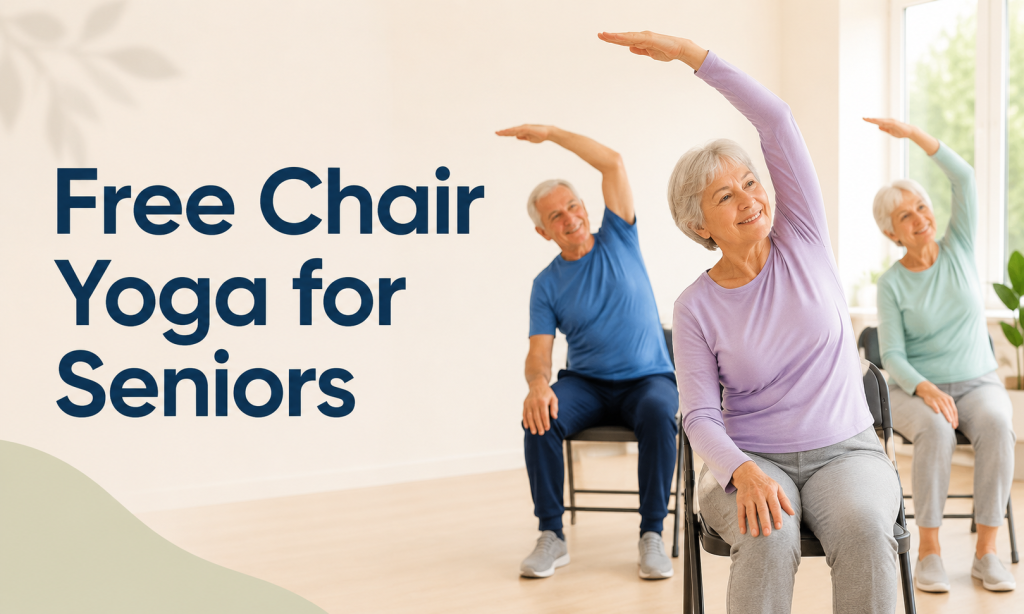
Chair yoga adapts traditional poses so they can be done while seated, or while standing and holding onto the chair for support. Nothing about the movement requires getting down to a mat or balancing without help.
It still includes the same core elements as a regular yoga class: breathing work, gentle stretching, and a few minutes of rest or reflection at the end.
Why It Works So Well for Older Adults
A 2024 study published in the Journal of Applied Gerontology found that chair yoga reduced anxiety and depression and improved mood among older adults living in care homes.
Other research has linked it to better hand grip strength, improved limb endurance, and better agility after a 12 week program, along with reduced joint pain in adults with osteoarthritis after just 8 weeks.
Who Benefits Most
- Seniors managing arthritis or chronic joint pain
- Older adults recovering from surgery or a recent injury
- Anyone dealing with a fear of falling, even without a recent fall
- People who find standing yoga classes physically inaccessible but still want the benefits
What the Research Actually Found
| Study | Population | Key Finding |
| 2024, care home study | Older adults in residential care | Reduced anxiety and depression, improved mood |
| 2012 study, 8 weeks | Older adults with a median age of 88 | Improved mobility and decreased fear of falling, no adverse effects |
| 12 week program | 35 older women in community care | Improved hand grip strength, limb endurance, balance, and agility |
| 8 week program | Older adults with osteoarthritis | Reduced joint pain |
| 2023 study | 85 women with knee osteoarthritis | Improved overall functional fitness |
A Typical Session, Step by Step
- A few minutes of seated breathing to settle in and check posture
- Gentle seated stretches for the neck, shoulders, and spine
- Seated twists and forward folds to ease tension through the back
- Standing poses using the chair for support, skipped entirely if balance is a concern
- A few minutes of rest at the end, simply focusing on slow, steady breathing
A Real Example Worth Knowing
In that 2012 study of older adults with a median age of 88, participants completed just 8 weeks of regular chair yoga. The result wasn’t only physical. Their reported fear of falling dropped, alongside measurable improvements in mobility, with no adverse effects recorded.
That detail matters because fear of falling on its own can limit how much someone moves, which can quietly worsen the very weakness that increases fall risk in the first place.
Common Mistakes and Safety Notes

- Using an unstable or wheeled chair: a solid, armless chair that won’t slide is essential for the standing portions.
- Skipping standing poses with no spotter or support: it’s fine to stay fully seated for an entire session if balance feels uncertain.
- Starting right after surgery without medical clearance: chair yoga is commonly used in rehab, but a doctor or physical therapist should confirm timing.
- Holding your breath during stretches: steady breathing throughout each pose is part of what makes the practice effective.
- Comparing your range of motion to a standing yoga class: chair yoga is its own practice, not a lesser version of something else.
Where to Find It for Free
| Resource | What It Offers | Cost |
| Yoga with Adriene (YouTube) | Large library including gentle, beginner friendly chair yoga sessions | Free |
| Sherry Zak Morris (YouTube) | Sessions specifically built for seniors and chair based practice | Free |
| SilverSneakers Chair Yoga (YouTube) | Instructor led classes designed around senior mobility levels | Free to watch on YouTube |
| Local senior centers and libraries | In person classes, often free or low cost for community members | Usually free or very low cost |
How to Set Yourself Up for Success
- Pick a sturdy, armless chair today: test that it doesn’t slide on your floor before your first session.
- Wear shoes with good grip, or go barefoot: socks alone can be slippery during the standing portions.
- Start with a 10 minute seated only video: build confidence before trying any session that includes standing poses.
- Practice at the same time each day: consistency tends to matter more than session length for seeing benefits.
Is Chair Yoga Safe for Someone With Osteoporosis?
Generally, yes, since it’s low impact and avoids the kind of forceful bending or twisting that can be risky with fragile bones. It’s still worth mentioning your specific diagnosis to a doctor before starting.
How Often Should Seniors Practice Chair Yoga?
Many of the studies showing benefit used sessions a few times a week over 8 to 12 weeks, though even occasional practice offers some benefit. Short daily sessions of 10 to 20 minutes are a reasonable starting target.
Do You Need Any Special Equipment to Start?
No. A sturdy chair is the only requirement. A strap, belt, or long towel can help with certain stretches, but none of it is mandatory to begin.
Can Chair Yoga Really Help With Fear of Falling?
Research suggests it can. An 8 week program in adults with a median age of 88 specifically found a reduction in fear of falling alongside improved mobility.
Is Chair Yoga Covered by Medicare or Insurance?
Coverage depends entirely on your specific plan. Some Medicare Advantage and supplemental plans include senior fitness programs that offer chair yoga at no extra cost, so it’s worth checking your plan’s fitness benefits directly.
What Most People Don’t Realize
Most people frame chair yoga purely as a physical practice, focused on flexibility and strength. The bigger overlooked benefit might actually be social. A widely cited 2010 meta-analysis covering 148 studies found that strong social connections were linked to a 50 percent higher chance of survival, an effect that appears even more pronounced among older adults specifically.
A weekly group chair yoga class, in person or live online, delivers that social connection alongside the physical benefits, which may be part of why community based programs tend to see such strong participation and consistency among seniors.
The Start Slow Ladder
If you’re brand new to this, a simple three step progression keeps things safe without slowing you down unnecessarily:
- Step One, fully seated: spend your first week or two with seated only sessions to build comfort and confidence.
- Step Two, chair supported standing: once seated movement feels easy, add in standing poses that use the chair for balance.
- Step Three, a structured multi week program: an 8 to 12 week program adds consistency and is the format most of the research above is actually based on.
What Should You Do Next?
If you’re getting started today, pick one free seated only video and try it before deciding whether standing poses feel right for you.
If you’re recovering from surgery or managing a balance condition, check with your doctor or physical therapist before adding standing poses, even chair supported ones.
Avoid skipping the warm up or jumping straight into a long, advanced session. Building up gradually is exactly what the research above was actually testing.
Suggested Internal Links
Add these once matching pages exist on your site, using descriptive anchor text:
- Link to a fall prevention guide using anchor text like “simple exercises that reduce fall risk”
- Link to a senior fitness programs overview using anchor text like “free and low cost fitness programs for older adults”
- Link to an arthritis management guide using anchor text like “gentle movement for joint pain relief”