

Here’s the Deal
Learning how to get rid of skunk smell starts with understanding why the odor is so hard to remove. Skunk odor comes from a sulfur-based oil called thiol, and the reason it is so stubborn is that thiols cling to oils, hair, fabric, and skin rather than washing away with plain soap and water. The good news is that a few household ingredients, mixed correctly, can neutralize the smell instead of just masking it.
Whether the smell is coming from a dog that got sprayed, your own clothing, your yard, or even your house after a skunk wandered too close, the removal approach is largely the same: break down the oil, do not just rinse it.
Fastest Fix at a Glance
| Where’s the Smell? | Best First Step |
| On a dog or pet | Hydrogen peroxide, baking soda, and dish soap mixture |
| On skin or hair | Diluted hydrogen peroxide rinse, then shampoo |
| On clothing or fabric | Soak in the same peroxide mixture before washing |
| In the yard or on a porch | Hose down the area and use an odor-neutralizing spray |
| Inside the house | Ventilate, then use baking soda and activated charcoal |
The Essentials
- Tomato juice does not actually remove skunk smell. It only masks it temporarily.
- A mixture of hydrogen peroxide, baking soda, and dish soap is the most effective DIY solution.
- Speed matters. Treating the smell within the first hour gives the best results.
- Never store the peroxide mixture in a sealed container, since it can build pressure.
- Multiple treatments may be needed for a full removal, especially on thick fur.
Why Skunk Spray Smells the Way It Does
The Chemistry Behind It
Skunks spray an oily liquid containing compounds called thiols, which are sulfur-based molecules known for an intensely strong, lingering odor. These thiols bond easily with oils on skin, fur, and fabric, which is part of why the smell sticks around so much longer than typical odors.
Why It Spreads So Easily
Because the spray is oil-based, it doesn’t dissolve well in water alone. Rinsing with water can actually spread the oil over a larger area rather than removing it, unless it’s paired with something that breaks the oil down.
How Far the Smell Can Travel
Under the right wind conditions, skunk odor can be detected from a significant distance, which is why a spray event nearby can leave an entire yard or even parts of a house smelling affected.
Why People Struggle to Get Rid of It
A lot of the difficulty comes down to using the wrong method. Tomato juice, the most commonly cited home remedy, has been tested repeatedly and shown to simply overpower the smell temporarily rather than neutralize it chemically. Once the tomato scent fades, the underlying skunk odor often comes right back. Understanding the actual chemistry, that thiols need to be broken down rather than covered up, is the key to actually solving the problem.
The Most Effective DIY Skunk Odor Remover
What You’ll Need
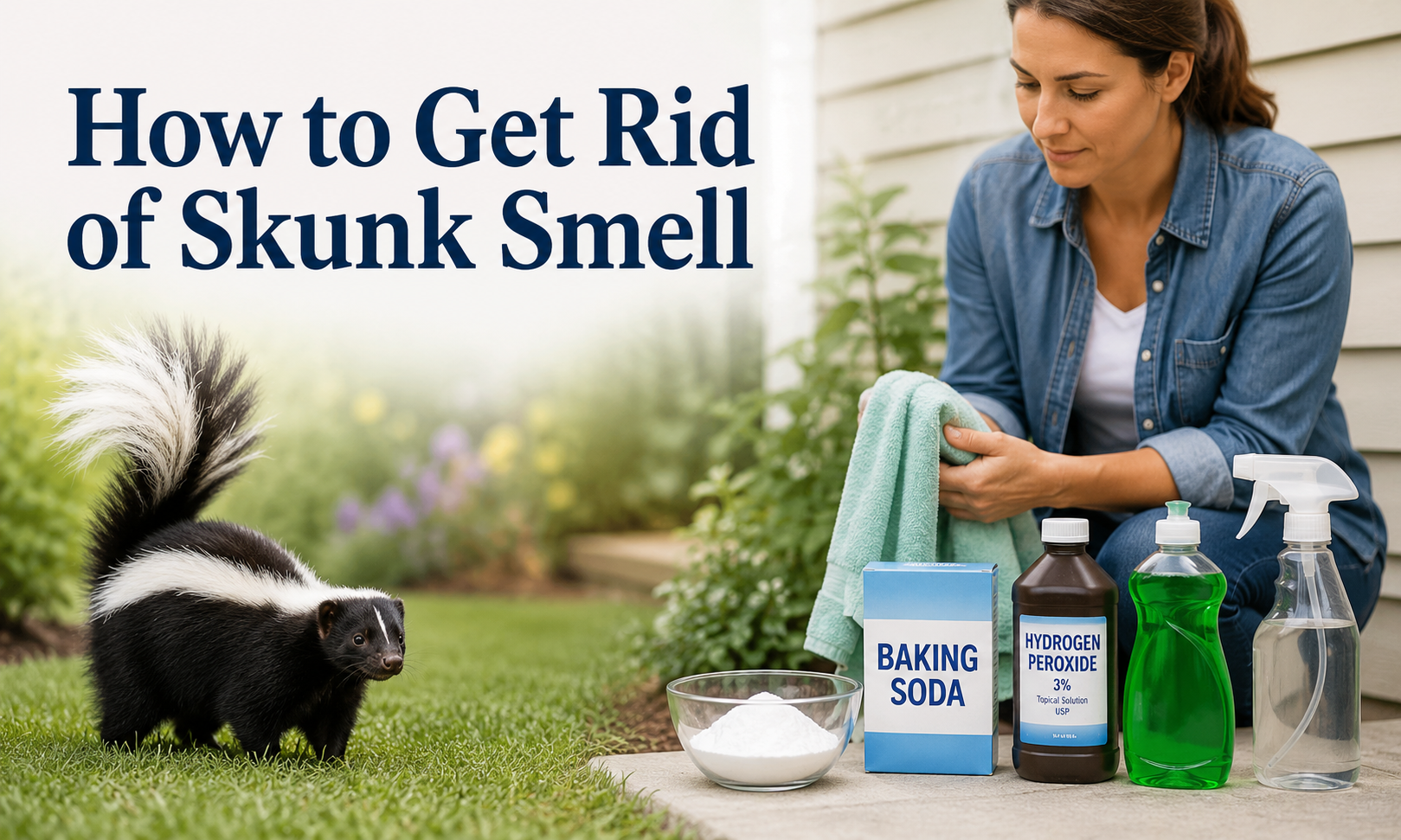
- 1 quart of 3 percent hydrogen peroxide
- 1/4 cup baking soda
- 1 to 2 teaspoons of liquid dish soap
How It Works
Hydrogen peroxide chemically breaks down the thiol molecules, baking soda helps absorb and neutralize remaining odor, and dish soap cuts through the oily residue so it can rinse away rather than spread.
Mix this solution fresh each time and use it immediately. Do not store it in a closed bottle, as the chemical reaction can cause pressure to build up.
Removing Skunk Smell From a Dog or Pet
- Check the Eyes First — If your pet was sprayed close to the face, rinse the eyes with cool water and watch for excessive redness or pawing.
- Work Outside if Possible — This keeps the smell from settling into your home during the process.
- Apply the Peroxide Mixture — Work it into the fur, avoiding the eyes, and let it sit for about 5 minutes.
- Rinse Thoroughly — Use warm water and make sure no residue is left behind.
- Follow With Regular Pet Shampoo — This helps remove any remaining oil and leaves the coat clean.
- Dry and Reassess — Some odor may remain after the fur dries; a second treatment can help if needed.
- Avoid Bathing in Tomato Juice — It won’t actually solve the underlying problem and can stain light-colored fur.
Removing Skunk Smell From Skin or Hair
For skin, a diluted version of the peroxide mixture (cut with extra water) can be used as a rinse before showering normally. For hair, working a small amount through the scalp and strands, then shampooing thoroughly afterward, usually helps significantly. Avoid getting the mixture in your eyes, and do a small patch test first if you have sensitive skin.
Removing Skunk Smell From Clothing and Fabric
| Item Type | Recommended Approach |
| Washable clothing | Soak in the peroxide mixture for 15–20 minutes, then machine wash with detergent |
| Shoes | Spot-treat with the mixture, air dry outdoors rather than indoors |
| Bedding or towels | Pre-soak, then wash on the hottest safe cycle for the fabric |
| Delicate fabrics | Test a small hidden area first, since peroxide can lighten some dyes |
Removing Skunk Smell From Your Yard or Home
Outdoor Areas
Hose down hard surfaces like decks, driveways, and siding where spray may have landed. An enzyme-based outdoor odor neutralizer, available at most hardware or pet stores, can help break down lingering residue on porous surfaces like wood or concrete.
Indoor Spaces
Open windows to ventilate the area as much as possible. Bowls of baking soda or activated charcoal placed around the room can help absorb lingering odor over the following day or two. For carpets or upholstery, a fabric-safe enzyme cleaner formulated for odor removal tends to work better than air fresheners, which only mask the smell.
Effects of Skunk Odor Exposure
Mild, Temporary Effects
Most people experience nothing more than discomfort from the smell itself, along with possible mild eye irritation or a headache from prolonged exposure in an enclosed space.
More Significant Reactions
In rare cases, particularly with direct spray to the face, some people or pets may experience temporary eye irritation, excessive tearing, or mild nausea from the strength of the odor.
When It’s More Than Just a Smell
If a pet was sprayed at extremely close range and shows signs of pawing at the eyes, drooling excessively, or vomiting, it’s worth a quick call to a veterinarian, since this can occasionally indicate a more direct exposure than typical.
Who Should Be Extra Careful When Treating Skunk Spray
- Anyone with sensitive skin should patch-test the peroxide mixture first
- People with respiratory sensitivities should treat strong odors in a well-ventilated area
- Pet owners should keep the mixture away from a pet’s eyes, nose, and mouth
- Households with light-colored fabric or fur should be cautious, since peroxide can lighten color
- Anyone whose pet shows signs of direct eye exposure should consult a vet rather than self-treating
Mistakes That Make the Smell Worse or Last Longer
| Common Mistake | Why It Backfires |
| Relying only on tomato juice | Masks the smell temporarily instead of neutralizing it |
| Storing the peroxide mixture in a sealed bottle | Pressure can build up and cause the container to burst |
| Bathing pets in hot water | Hot water can open pores and intensify the smell temporarily |
| Skipping a second treatment | A single round often isn’t enough for heavy or close-range spray |
| Using scented air fresheners indoors | Mixes with the existing odor rather than removing it |
DIY Peroxide Mix vs Store-Bought Skunk Odor Removers
| Feature | DIY Peroxide Mixture | Store-Bought Removers |
| Cost | Very low, household ingredients | Moderate, pre-formulated product |
| Availability | Most people have ingredients on hand | Requires a store trip if not already owned |
| Effectiveness | Very effective when made and used correctly | Effective and consistent, formulated specifically for this |
| Best for | Immediate at-home treatment | Convenience or repeat use without mixing |
What’s True and What’s Not
| Myth | Fact |
| Tomato juice removes skunk smell | It only temporarily masks the odor rather than breaking it down |
| The smell will just go away on its own quickly | Without treatment, residual odor can linger for days or longer |
| Any soap will work just as well | Standard soap doesn’t break down the oil-based thiols effectively |
| Skunk spray is dangerous to humans | It’s unpleasant and can mildly irritate eyes, but isn’t typically dangerous |
What the Experts Recommend
The peroxide, baking soda, and dish soap formula is widely credited to chemist Paul Krebaum and has since been recommended by veterinary and wildlife organizations, including the Humane Society, as a more effective alternative to tomato juice for treating skunk odor on pets and surfaces.
When to Call a Professional or Vet
Reach out to a veterinarian if your pet was sprayed directly in the face and is showing signs of eye irritation that doesn’t improve, persistent drooling, or repeated pawing at the face. For severe indoor odor that won’t lift after a few days of treatment, a professional odor remediation service can help, particularly if the smell has settled into HVAC systems or deep into carpeting.
Preventing Future Skunk Encounters
- Keep trash cans tightly sealed, since food smells attract skunks
- Avoid leaving pet food outside overnight
- Seal off potential den spaces under decks or sheds
- Use motion-activated lights or sprinklers in areas skunks frequent
- Walk pets on a leash in the evening, when skunks are most active
Wrapping Up
Skunk odor is unpleasant but very manageable once you understand that it needs to be chemically broken down, not just covered up. A simple peroxide, baking soda, and dish soap mixture handles most situations effectively, whether it’s on a pet, your skin, clothing, or around your home. Acting quickly and repeating treatment if needed will get you back to normal faster than waiting it out.
Common Questions
Does tomato juice actually work on skunk smell?
Not really. It temporarily masks the odor with a stronger smell of its own, but it doesn’t break down the oils causing the smell, so the skunk odor typically returns.
How long does skunk smell usually last?
Without treatment, it can linger for one to three weeks, though proper treatment can significantly reduce it within a day.
Can I use the peroxide mixture on my dog’s face?
Use it very carefully and avoid the eyes, nose, and mouth. A washcloth dabbed with diluted mixture is safer for facial areas than pouring it directly.
Is it safe to make the peroxide mixture ahead of time?
It’s best made fresh each time and used immediately, since storing it in a sealed container can cause pressure buildup.
Will skunk smell damage my car or home?
It generally won’t cause physical damage, but the odor can linger in fabric, carpet, and ventilation systems if not treated.
Can humans get sprayed directly by a skunk?
Yes, especially if startled at close range. The treatment approach is similar to that used for pets, with extra care around the eyes.
Does washing clothes multiple times help?
Yes, especially when combined with a pre-soak in the peroxide mixture before each wash, rather than washing alone.
Are commercial skunk odor removers worth buying?
They can be a convenient, ready-made option, particularly for households that want a no-mix solution on hand.