

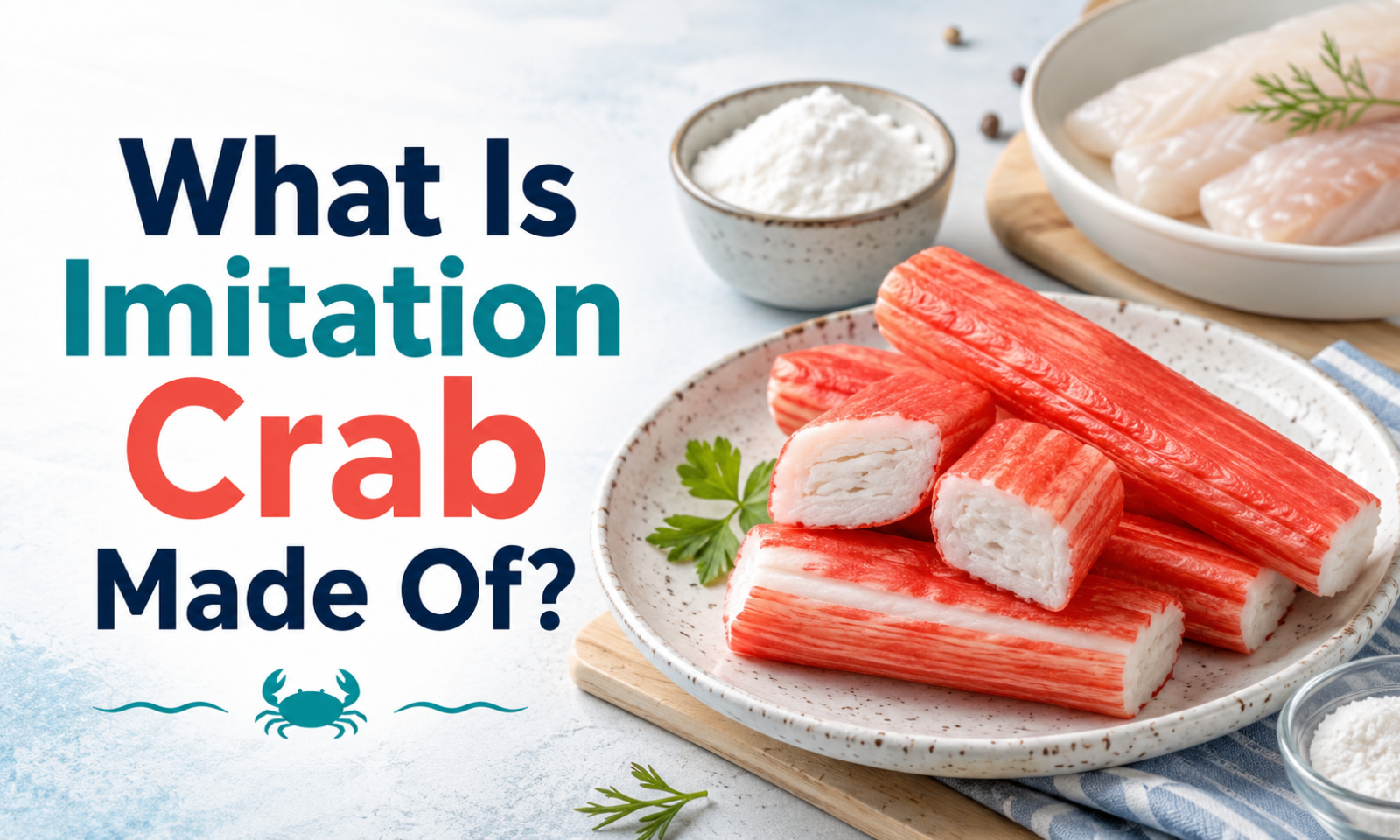
Spoiler up front: there is usually no crab in imitation crab. If you have ever wondered what is imitation crab made of, the answer is a mix of processed white fish and a handful of additives working together to fake the look, texture, and flavor of real crab meat. Here is what each part of the label really means.
The Short Answer
Imitation crab is made primarily from surimi, a paste of deboned, washed, and minced white fish, most commonly Alaska pollock. Surimi typically makes up 35% to 50% of the final product by weight. The rest is water, starch, egg whites, sugar, salt, and a small amount of crab flavoring or crab extract, along with food coloring to give it that familiar red-orange stripe. It’s fully cooked during manufacturing, so it’s ready to eat straight from the package.
Decoding the Ingredient List
Here’s what each item on a typical imitation crab label is actually doing, translated out of food-science language:
| Ingredient | % of Product | What It’s Actually For |
| Surimi (white fish paste) | 35–50% | The base ingredient; usually Alaska pollock, sometimes cod, hake, or Pacific whiting |
| Water | Largest of the remaining % | Helps create the right texture and moisture level |
| Starch (wheat, potato, tapioca, or corn) | Varies by brand | Firms up the surimi and helps it hold together when frozen and thawed |
| Egg whites | Small amount | Acts as a binder, helping the mixture hold its shape |
| Sugar / sorbitol | Small amount | Balances flavor and helps preserve texture during freezing |
| Salt (sodium or potassium chloride) | Small amount | Enhances flavor and helps the fish protein form a gel-like structure |
| Crab extract or flavoring | Very small amount | Provides the crab-like taste; may include a small amount of real crab or be entirely artificial |
| Red/orange coloring (often carmine, paprika, or lycopene) | Surface only | Applied to the outside to mimic the look of cooked crab shell |
| Stabilizers (xanthan gum, carrageenan) | Small amount | Help everything bind into a consistent, sliceable texture |
How It’s Actually Made: From Ocean to Package
- Wild-caught white fish, most often Alaska pollock, is harvested and brought to processing facilities.
- The fish is deboned, cleaned, and washed repeatedly to remove fat, blood, and strong-tasting compounds, leaving behind a bland white protein.
- The washed fish is minced into a paste, this is the surimi, and often frozen into blocks for storage and transport.
- When it’s time to make imitation crab, the surimi is thawed and blended with water, starch, egg whites, sugar, salt, and crab flavoring.
- The mixture is heated and pressed into shapes that mimic crab leg meat, often as long sticks or flat sheets.
- A stripe of red or orange coloring is applied to the surface to resemble the shell coloring of cooked crab.
- The finished product is vacuum sealed and pasteurized, which is why it’s safe to eat directly from the package without additional cooking.
Real Crab vs. Imitation Crab: Nutrition Side-by-Side
Because imitation crab gets a large share of its calories from added starch rather than protein, the nutrition profile looks noticeably different from the real thing:
| Nutrient (per ~3 oz) | Real Crab Meat | Imitation Crab | What This Means |
| Protein | Higher | Lower | Real crab is a more concentrated protein source |
| Carbohydrates | Very low | Higher | Starch fillers add carbs that real crab doesn’t have |
| Sodium | Moderate | Often higher | Salt is added both for flavor and texture |
| Omega-3 fatty acids | Higher | Lower (unless fortified) | Washing during surimi processing removes much of the natural fish oil |
| Vitamin B12 & zinc | Higher | Lower | These nutrients are largely lost during the washing and processing steps |
Is It Safe to Eat? A Few Things Worth Knowing
Shellfish Allergies
This is the big one. Even though most imitation crab contains no real crab, it often includes crab extract or flavoring derived from actual shellfish, and it may be processed in facilities that also handle real shellfish. People with shellfish allergies are generally advised to avoid imitation crab entirely rather than assume it’s a safe substitute.
Labeling Accuracy
Because surimi manufacturing involves multiple ingredients and sourcing from various fish species, labeling isn’t always precise. Testing of surimi products sold in parts of Europe found that a notable share listed a different fish species than what DNA analysis actually identified, with most mislabeled products traced back to certain import sources. In a couple of cases, the actual fish used was one associated with a foodborne toxin risk. This doesn’t mean most imitation crab is unsafe, but it’s a reason labeling laws and country-of-origin sourcing matter.
Sodium Content
A single serving of imitation crab can provide a meaningful chunk of a day’s recommended sodium intake, something worth factoring in if you’re watching sodium for blood pressure or other health reasons.
Where the Fish Actually Comes From
Alaska pollock remains the dominant fish used in surimi worldwide, prized for its mild flavor and abundance. Some brands specifically market their use of a single, traceable, sustainably certified fishery, while lower-cost products may blend in other white-fleshed fish like Pacific whiting, threadfin bream, or cutlassfish, species with less consistent texture and flavor. Overfishing concerns have been raised around certain pollock stocks in the past, tied to the broader marine food chain, including species that rely on pollock as a food source, though sustainably certified pollock fisheries are increasingly common.
What to Look for on the Label if You’re Buying It
- Check whether the fish species is named specifically (like “Alaska pollock”) rather than a vague “whitefish” or “surimi” listing with no source given
- Look for a sustainability certification, such as Marine Stewardship Council (MSC), if that matters to you
- Read the allergen statement closely if you or someone you’re cooking for has a shellfish allergy
- Compare sodium content between brands, since it can vary meaningfully
- Look for “additive-free” or “clean label” versions if you want to avoid things like added MSG or artificial dyes; these tend to substitute ingredients like paprika extract, oat fiber, or cane sugar instead
Quick Answers
Does imitation crab have any real crab in it?
Sometimes a small amount is added purely for flavor, but the vast majority of the product, and often all of it, is fish-based surimi rather than actual crab meat.
Is imitation crab healthier or less healthy than real crab?
It’s generally lower in protein, omega-3s, and certain vitamins, and higher in carbs and sodium, making real crab the more nutrient-dense option, though imitation crab is also lower in cholesterol and fat.
Can people with fish allergies eat imitation crab?
No. Since imitation crab is primarily made from fish, it’s not a safe option for anyone with a fish allergy, and it’s also generally not recommended for people with shellfish allergies due to potential cross-contact or crab-derived flavoring.
Why is imitation crab so cheap compared to real crab?
Because it’s made mostly from an abundant, inexpensive fish (pollock) bulked up with water and starch, it costs a fraction of what real crab meat costs to produce.
Is imitation crab cooked or raw?
It’s fully cooked and pasteurized during manufacturing, so it’s safe to eat straight from the package without any additional cooking.
This article is for general informational purposes. If you have a shellfish or fish allergy, always check product labels carefully and consult an allergist with questions about specific ingredients.