

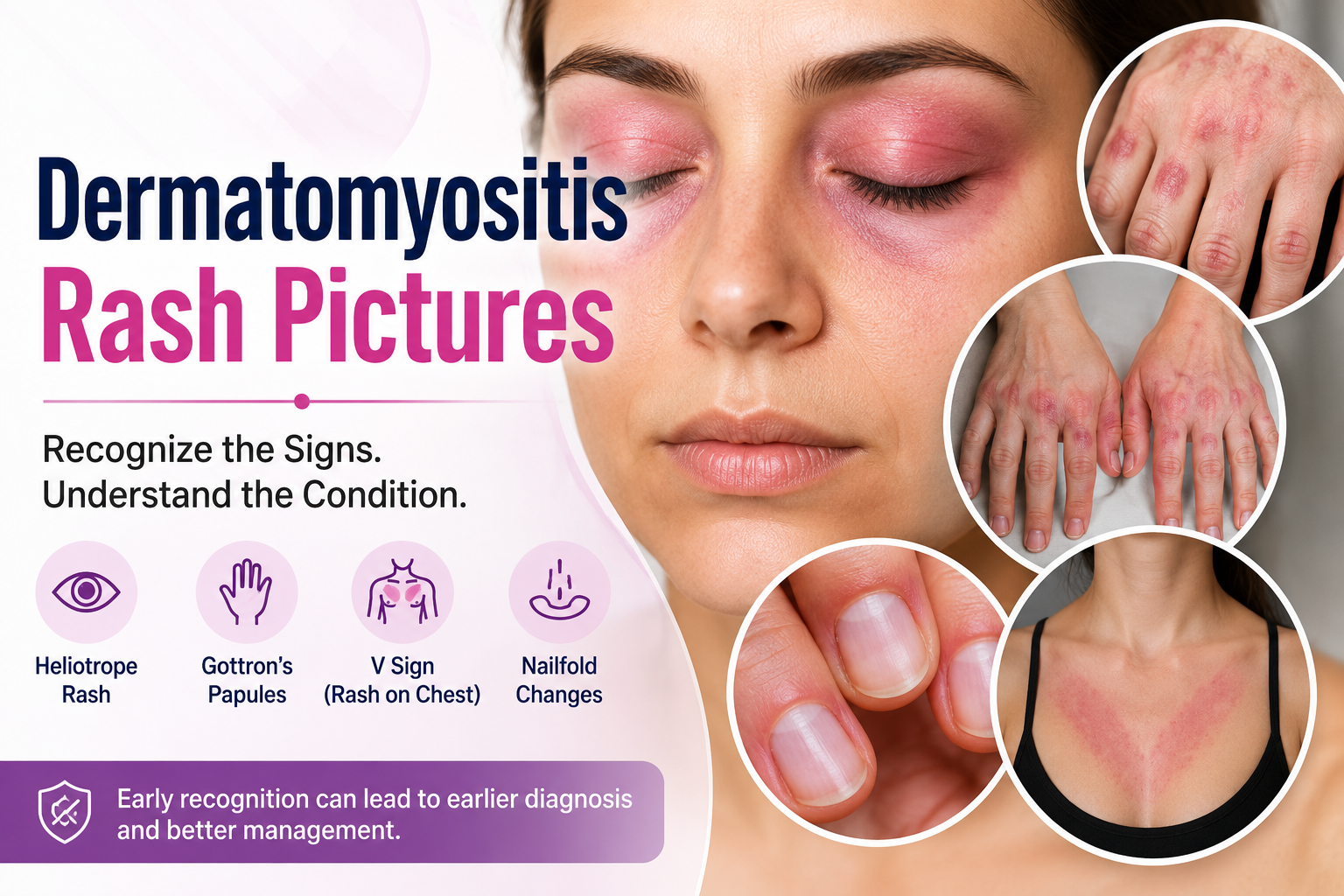
The dermatomyositis rash is one of the more distinctive skin findings in medicine, and doctors rely on its specific patterns to help diagnose this rare autoimmune condition. For readers comparing dermatomyositis rash pictures with their own symptoms, it is important to understand that diagnosis depends on recognized rash patterns, not images alone. According to the Myositis Association’s diagnostic criteria for dermatomyositis, a diagnosis requires at least one of several characteristic skin findings, most notably a heliotrope rash or Gottron’s papules, alongside muscle weakness and other supporting test results.
What Is Dermatomyositis?
Dermatomyositis is a rare autoimmune condition that causes inflammation in both the skin and the muscles, most often affecting the muscles closest to the trunk of the body, like the hips, thighs, shoulders, and neck. It can occur in both adults and children (called juvenile dermatomyositis), and skin changes sometimes appear before muscle weakness develops, which is often what prompts the first doctor’s visit.
The Specific Rash Patterns, Described in Detail
Rather than one single rash, dermatomyositis produces several recognized, named patterns that together help distinguish it from other skin conditions:
| Sign Name | Where It Appears | What It Looks Like |
| Heliotrope rash | Upper eyelids, often both sides | A violet, purple, or reddish discoloration, sometimes with swelling; can be subtle and look like just a bit of eyelid darkening in some cases |
| Gottron’s papules | Knuckles, over the finger joints | Raised, flat-topped bumps that are red, purple, or violet in color, sometimes with fine scaling |
| Gottron’s sign | Elbows and knees | Flat, reddish or violet discolored patches, without the raised bump texture seen in Gottron’s papules |
| Shawl sign | Back of the neck, shoulders, and upper back | A reddish rash following a shawl-like distribution across sun-exposed skin |
| V-sign | Front of the neck and upper chest | A reddish, V-shaped rash in a sun-exposed distribution |
| Holster sign | Outer hips and thighs | Reddish or violet discoloration along the side of the hip, resembling where a holster would sit |
| Periungual changes | Skin folds around the fingernails | Small red dots or visibly dilated tiny blood vessels at the nail folds |
| Mechanic’s hands | Palms and sides of the fingers | Thickened, cracked, rough skin resembling calluses, sometimes with a dirty appearance that doesn’t wash off |
Several of these patterns, including the shawl sign and V-sign, tend to appear or worsen on skin that’s been exposed to the sun, since photosensitivity is a common feature of this condition.
Other Skin and Physical Changes That Can Occur
- Calcinosis cutis: hard calcium deposits under the skin, more common in juvenile dermatomyositis and in longstanding disease
- Poikiloderma: a mix of skin thinning, pigment changes, and visible small blood vessels, giving the skin a mottled, patchy appearance
- Scalp involvement: scaling and redness of the scalp, sometimes with hair thinning or loss
- Nail fold changes: visible small red dots or thread-like lines at the base of the fingernails from dilated capillaries
Muscle Symptoms That Often Accompany the Rash
Along with skin changes, most people with dermatomyositis develop symmetric muscle weakness, typically affecting the muscles closest to the trunk first, such as the hips, thighs, shoulders, and neck. This can make tasks like climbing stairs, standing from a seated position, or lifting the arms overhead noticeably more difficult. In some cases, skin changes appear without significant muscle weakness at all, a pattern sometimes referred to as amyopathic or clinically amyopathic dermatomyositis.
| ⚠ WHY DIAGNOSIS MATTERS QUICKLY
In adults, dermatomyositis is sometimes associated with an underlying cancer, particularly in the months surrounding diagnosis, which is why doctors often recommend age-appropriate cancer screening alongside dermatomyositis workup. This doesn’t mean a cancer diagnosis is likely for everyone with dermatomyositis, but it’s a key reason this rash pattern should be evaluated promptly by a doctor rather than treated as a routine skin issue. |
How Doctors Diagnose Dermatomyositis
According to Cleveland Clinic’s overview of Gottron papules, a provider will typically examine the specific pattern and location of any rash alongside checking for muscle weakness. Diagnosis often involves blood tests for muscle enzymes like creatine kinase, autoantibody testing, and sometimes a skin or muscle biopsy or MRI to confirm inflammation in the muscle tissue.
Living With a Chronic Diagnosis: The Emotional Side
A visible, chronic skin and muscle condition like dermatomyositis can carry a real emotional weight alongside the physical symptoms, including anxiety about flares, self-consciousness about visible rashes, and the general adjustment of living with a long-term autoimmune disease. This is a normal and common experience, and it’s worth taking seriously rather than pushing through quietly. If a chronic illness diagnosis is affecting your mental health, mood, or ability to cope day to day, reaching out to a mental health provider or a facility like Conway Behavioral Health, which offers care for adults and adolescents navigating anxiety, depression, and other mental health challenges, can be a meaningful part of your overall care plan alongside your rheumatologist or dermatologist.
Treatment Approaches
- Corticosteroids, often the first-line treatment to reduce inflammation in both skin and muscle
- Immunosuppressive medications, such as methotrexate or azathioprine, often used to reduce long-term steroid use
- Topical treatments and rigorous sun protection to help manage skin-specific symptoms and reduce photosensitivity flares
- Physical therapy to help maintain muscle strength and function during and after flares
- Regular monitoring for potential complications, including lung involvement and, in adults, age-appropriate cancer screening
When to See a Doctor
See a doctor promptly if you notice a persistent purple or reddish rash on your eyelids or knuckles, especially alongside new muscle weakness, difficulty climbing stairs, or trouble lifting your arms overhead. Because dermatomyositis can be associated with other underlying conditions and can affect organs beyond the skin and muscles, early evaluation matters even if symptoms seem mild at first.
Quick Answers
What does a dermatomyositis rash look like?
It commonly appears as a violet or reddish discoloration on the upper eyelids (heliotrope rash) and raised, discolored bumps over the knuckles (Gottron’s papules), sometimes alongside a rash on the neck, chest, or hips in sun-exposed areas.
Is the dermatomyositis rash itchy or painful?
It can be itchy, and sun-exposed areas may feel more irritated after exposure, though the rash itself is not always painful.
Can dermatomyositis occur without muscle weakness?
Yes, this is called amyopathic or clinically amyopathic dermatomyositis, where the characteristic skin findings appear without significant, detectable muscle involvement.
Is dermatomyositis linked to cancer?
In adults, there’s a recognized association with an increased risk of underlying cancer around the time of diagnosis, which is why doctors often recommend age-appropriate cancer screening as part of the workup.
Can children get dermatomyositis?
Yes, this is called juvenile dermatomyositis, and it shares many of the same skin and muscle features seen in adults, sometimes with a higher likelihood of calcinosis (calcium deposits under the skin).
How is dermatomyositis treated?
Treatment typically starts with corticosteroids and may include additional immunosuppressive medications, sun protection, and physical therapy, tailored to the severity of skin and muscle involvement.
This article is for general educational purposes only and is not a substitute for professional medical evaluation. See a doctor or dermatologist promptly if you notice a persistent rash matching these patterns, especially alongside muscle weakness.