

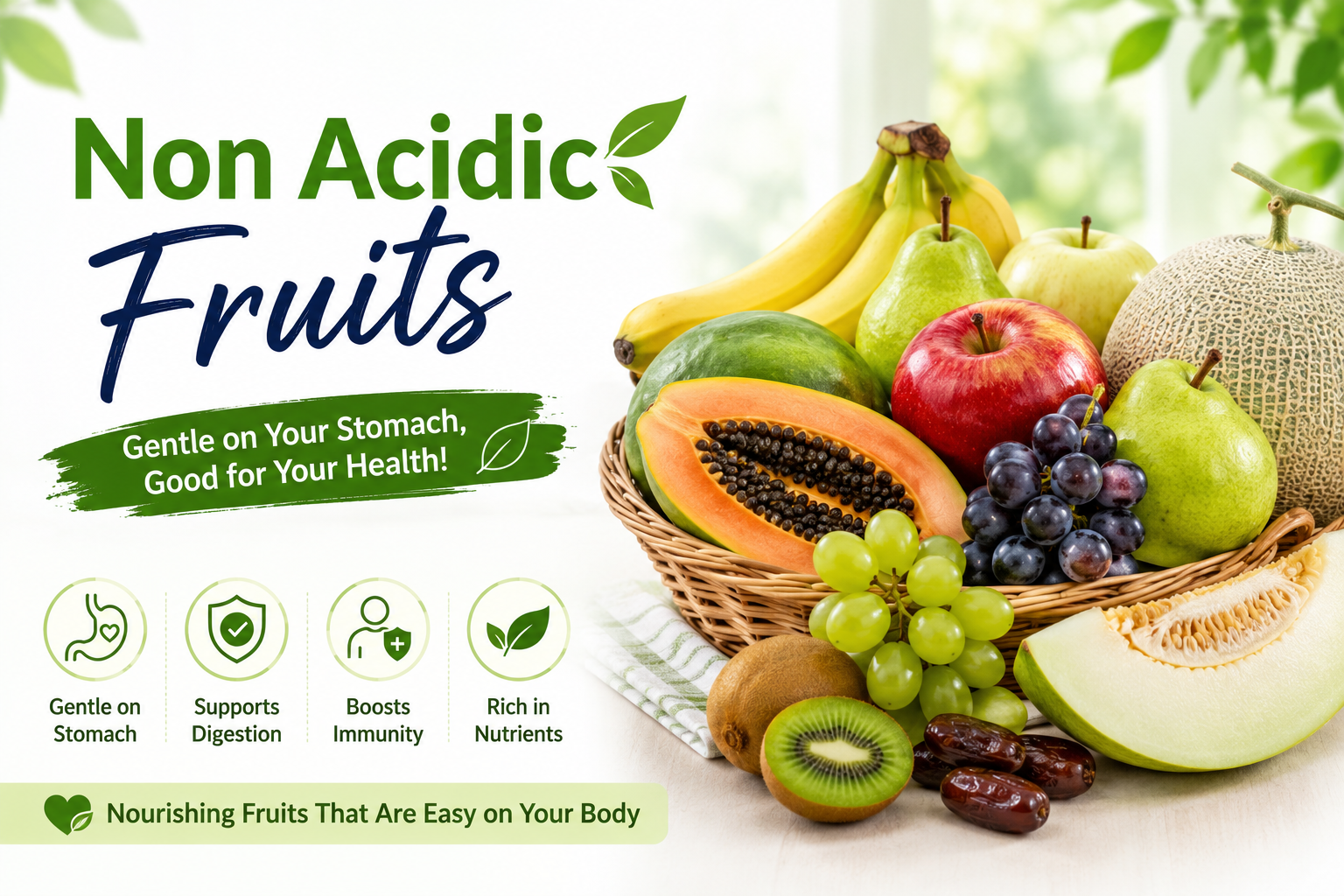
If heartburn or reflux has you scanning the produce aisle with suspicion, the good news is that non acidic fruits still leave you with plenty of real options, bananas, melon, papaya, and a handful of others sit gently enough on the pH scale that most people with acid reflux tolerate them well. You don’t have to give up fruit entirely, you just have to get pickier about which ones.
Here’s the actual pH breakdown, which fruits consistently show up as safe bets, which ones are worth testing carefully rather than avoiding outright, and why fruit choice matters for reflux in the first place.
Quick Refresher: What ‘Acidic’ Actually Means Here
pH is measured on a scale of 0 to 14, with 7 being neutral. Lower numbers mean more acidic, higher numbers mean more alkaline. Most fruits fall somewhere below neutral, but the range within “acidic” is enormous, lemons sit around pH 2, while a ripe banana sits around pH 5, which is a meaningful difference for a sensitive esophagus. When people talk about “non-acidic” fruit, they generally mean anything above roughly pH 4.5.
The Fruits That Consistently Rank Lowest in Acid
| Fruit | Approx. pH | Why It’s Usually Well Tolerated |
| Banana (ripe) | ~5.0 | Low acid, high fiber, may even help buffer stomach acid |
| Cantaloupe | ~6.1 | High water content, mild and easy to digest |
| Honeydew melon | ~6.0 | Similar to cantaloupe, gentle and hydrating |
| Watermelon | ~5.5 | Very high water content dilutes rather than irritates |
| Papaya | ~5.5 | Contains papain, an enzyme that may actually support digestion |
| Avocado | ~6.3 to 6.6 | Technically a fruit, very low acid, high in healthy fat and fiber |
| Dates | ~5.7 to 5.9 | Naturally sweet, low acid, good for baking or smoothies |
| Figs (fresh) | ~5.0 to 6.0 | Fresh, not dried, tends to sit better for sensitive stomachs |
Fruits That Are Fine for Some People, Riskier for Others
| Fruit | The Nuance |
| Ripe mango | Around pH 5.9 when fully ripe, but unripe mango drops closer to pH 4.5, ripeness matters a lot here |
| Blueberries | More neutral than most berries, but still mildly acidic, tolerance varies by person |
| Pears | Generally low acid and alkaline-leaning, a solid choice for most people |
| Apples (peeled, ripe) | Lower acid than citrus, but skin and tartness can vary by variety |
| Persimmons | More acidic than the top-tier list but still tolerable for many, choose ripe Fuyu over astringent Hachiya |
The Fruits Most Likely to Trigger Symptoms
- Oranges, grapefruit, lemons, and limes, all classic high-acid citrus, often below pH 3.5
- Pineapple, notably acidic and also contains enzymes that can irritate a sensitive esophagus
- Tomatoes, technically a fruit, and one of the most common reflux triggers overall
- Strawberries specifically among berries, more acidic than blueberries or blackberries
- Cranberries, both fresh and as juice
Why This Is Worth Getting Right, Not Just Avoiding Citrus
This isn’t just about dodging discomfort in the moment. Research has found that people with the highest overall fruit intake had roughly 25% lower odds of developing GERD compared to those with the lowest intake, and fiber specifically has been linked to reduced reflux symptoms in clinical research. That makes low-acid fruit less of a restriction and more of a genuine opportunity, you’re not just avoiding a trigger, you’re actively supporting digestive health by choosing the right produce instead of cutting fruit out altogether.
A Few Practical Details That Actually Matter
- Ripeness changes acidity significantly, an underripe mango or banana is meaningfully more acidic than a fully ripe one.
- Portion size still matters, even low-acid fruit can trigger symptoms if you overdo it in one sitting; roughly half to one cup per serving is a reasonable starting point.
- Skip added sugar or honey on low-acid fruit, since sugar itself can increase stomach acid production.
- Blend gently rather than juicing when possible, whole fruit with its fiber tends to be better tolerated than concentrated juice.
- Keep a simple food log for a couple of weeks, tolerance genuinely varies person to person, and the general lists here are a starting point, not a guarantee.
- Avoid eating fruit, or anything else, within 2 to 3 hours of lying down, since positioning affects reflux as much as food choice does.
The Trigger That Has Nothing to Do With What’s On Your Plate
Diet gets most of the attention in reflux management, but stress is a well-documented contributor in its own right. Elevated stress hormones can increase stomach acid production and relax the lower esophageal sphincter, the valve that’s supposed to keep acid where it belongs, which is part of why some people notice their reflux flares during stressful stretches even when their diet hasn’t changed at all.
If stress feels like a consistent factor behind your symptoms, alongside diet rather than instead of it, that’s worth addressing directly. Conway Behavioral Health treats stress and anxiety at multiple levels of care, and managing that side of the equation can meaningfully support whatever dietary changes you’re already making.
A Couple of Things Worth Clarifying
“Alkaline” fruit doesn’t mean it changes your overall body pH. Your blood pH is tightly regulated regardless of diet, the benefit here is local, less irritation to the esophagus, not a systemic pH shift.
Not all berries behave the same way. Strawberries are notably more acidic than blueberries, so lumping “berries” together as one category misses meaningful differences.
A food being low-acid doesn’t guarantee it won’t bother you. Individual tolerance varies, and factors like portion size, ripeness, and what you eat alongside it all matter too.
Bottom Line
Bananas, melon, papaya, avocado, dates, and fresh figs consistently rank among the lowest-acid fruit options and are well tolerated by most people managing reflux, while citrus, pineapple, tomatoes, and strawberries tend to be the most common triggers. Ripeness, portion size, and preparation all shift where a given fruit lands, so this list is a strong starting point rather than a rigid rulebook, tracking your own response over a couple of weeks will tell you more than any general list can.
Common Questions About Non-Acidic Fruits
What is the least acidic fruit overall?
Avocado and cantaloupe both rank among the lowest, generally sitting above pH 6, making them well tolerated by most people with acid reflux.
Are bananas really non-acidic?
Bananas are technically mildly acidic, around pH 5, but they’re low enough and gentle enough that they’re considered one of the most reflux-friendly fruit choices.
Can I still eat citrus occasionally if I have reflux?
Some people tolerate small amounts, especially paired with other food, but citrus remains one of the more common triggers, so it’s worth testing cautiously rather than assuming it’s fine.
Does ripeness really change how acidic a fruit is?
Yes, meaningfully, unripe fruit is generally more acidic than fully ripe fruit, which is why a barely-yellow banana or firm mango may bother you more than a fully ripe one.
Is fruit juice a good substitute for whole low-acid fruit?
Whole fruit is generally better tolerated, since juicing concentrates the acid and removes the fiber that helps buffer digestion.
How much low-acid fruit is safe to eat in a day?
There’s no universal number, but starting with half to one cup per serving and watching your body’s response is a reasonable, practical approach.
Are dried fruits as low-acid as fresh ones?
Not always, dried fruit can be more concentrated and sometimes more acidic than the fresh version, fresh figs, for example, are generally better tolerated than dried ones.
Should I see a doctor about reflux instead of just changing my diet?
If you’re experiencing reflux more than twice a week, or dietary changes aren’t helping, it’s worth talking to a doctor, since GERD sometimes needs more than diet adjustments to manage well.