

Quick Answer
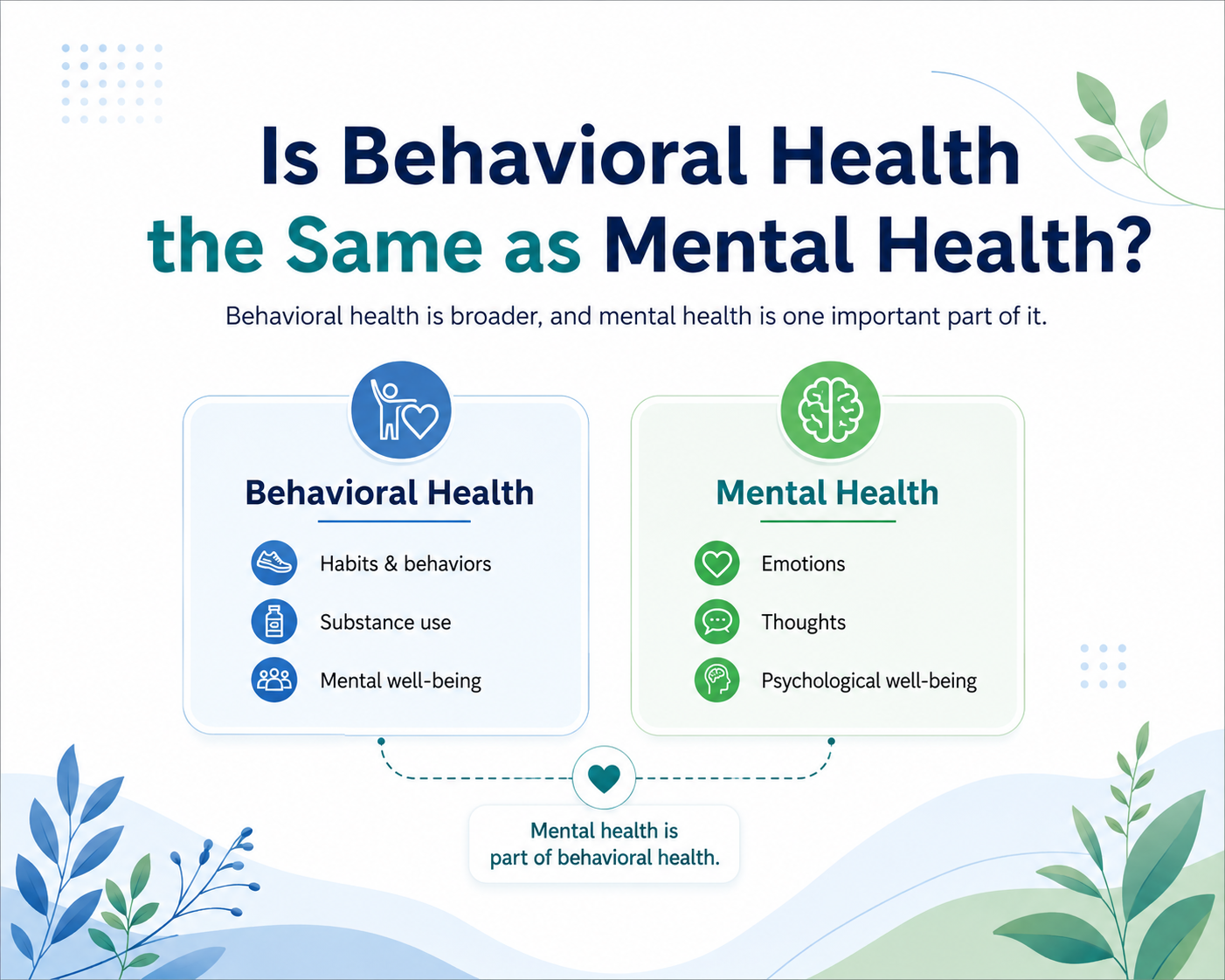
No, behavioral health and mental health aren’t technically identical. Is behavioral health the same as mental health? Not exactly. Mental health refers specifically to your emotional and psychological state, while behavioral health is the broader umbrella that also includes substance use and lifestyle habits. In day-to-day conversation, though, most people and even many providers use the two terms interchangeably, which is exactly why the question keeps coming up.
You Call Your Insurance Company, and It Gets Confusing Fast
You’re looking for therapy, so you call your insurance provider. They ask if you need your “behavioral health benefit” or your “mental health benefit” — and pause, waiting for you to pick one.
Most people have no idea there’s supposed to be a difference. Fair enough — even within healthcare, the two terms get used inconsistently depending on who’s talking.
Here’s where they actually line up, where they split, and why it rarely matters as much as it sounds like it should.
The Short Answer, Expanded
Mental health is the older, narrower term. It refers to your psychological and emotional functioning — things like mood, anxiety levels, and cognitive wellbeing.
Behavioral health is newer and wider. It includes mental health, but also folds in substance use and behavior patterns — eating habits, sleep, risk-taking — that affect your overall health, diagnosed or not.
So mental health usually sits inside behavioral health, not next to it. That’s the technical answer. The practical answer is that plenty of providers, insurers, and patients still swap the terms freely.
Where the Confusion Actually Comes From
| Source | Term They Tend to Use | Why |
| Federal law (MHPAEA) | “Mental health and substance use disorder (MH/SUD) benefits” | This is the precise legal language written into the parity law itself |
| Hospitals & treatment centers | “Behavioral health” | Used as a department-level umbrella covering multiple service lines at once |
| Therapists in private practice | “Mental health” | Simpler, more familiar term for everyday clinical conversation |
| Federal health agencies (public materials) | Both, often in the same sentence | Public-facing guidance tends to use the terms loosely and interchangeably |
Where the Two Terms Genuinely Overlap
For most everyday purposes, the overlap is huge. If someone says they’re seeking “mental health treatment” for anxiety, or “behavioral health treatment” for the same anxiety, they’ll likely end up at the same kind of provider, doing the same kind of therapy.
Insurance coverage for diagnosed psychiatric conditions — depression, anxiety disorders, bipolar disorder — typically falls under both labels without any practical difference in what’s covered.
Where They Actually Diverge
- Substance use disorders — almost always grouped under “behavioral health,” rarely described as a “mental health” issue on its own, even though the two are frequently treated together.
- Undiagnosed habits — things like chronic stress eating or compulsive screen use fall under behavioral health’s wider net, but wouldn’t typically be called a “mental health” concern unless tied to a diagnosis.
- Workplace and wellness programs — tend to favor “behavioral health” specifically because it can include coaching around habits, not just clinical treatment.
A Real Scenario That Shows the Difference
Picture two people calling the same clinic. One has generalized anxiety disorder with no other complicating factors — a textbook “mental health” case by almost any definition.
The other has binge-eating episodes tied to stress, but no formal anxiety or depression diagnosis. That second case sits squarely in behavioral health territory, and might not get labeled “mental health” at all, depending on the clinic’s intake paperwork.
Same building, same providers possibly — but only one of them cleanly fits the narrower term.
The Habit Test: A Quick Way to Tell Which One Applies
When you’re not sure which term fits your situation, three quick questions usually clear it up:
- Is there a formal diagnosis involved? If yes, “mental health” almost always applies, and so does “behavioral health” as the wider category.
- Is a habit or substance use pattern the main issue? If yes, you’re in behavioral health territory specifically, even without a diagnosis.
- Are you asking about insurance coverage? If yes, check your plan’s documents directly — some bundle both under one benefit, others split them.
What People Get Wrong When They Assume They’re Identical
- Assuming addiction treatment falls under “mental health” coverage — it’s usually billed and categorized as behavioral health, which can matter for prior authorization.
- Assuming every provider uses the terms the same way — they don’t — ask directly rather than guessing based on a website’s wording.
- Assuming the distinction is legally standardized — the core federal parity law uses neither term alone; it specifically says “mental health and substance use disorder.”
Does the Distinction Actually Matter for Your Treatment or Coverage?
- Pull up your insurance plan documents today — search for both “behavioral health” and “mental health” to see how your specific plan categorizes things.
- Ask a potential provider directly — “Does your behavioral health program include substance use treatment, or just mental health conditions?” is a fair, specific question.
- Don’t let the wording stop you from calling — if you’re unsure which department to ask for, most front desks can redirect you once they hear what you actually need.
Is Substance Use Treatment Considered Mental Health or Behavioral Health?
It’s almost always categorized as behavioral health, even though substance use disorders are recognized psychiatric diagnoses. The broader behavioral health label is what insurers and treatment centers use most consistently.
Why Does My Insurance Card Say “Behavioral Health” Instead of “Mental Health”?
Insurers tend to use “behavioral health” as the umbrella billing category because it covers both mental health and substance use benefits under one heading, which simplifies plan documentation.
If My Therapist Calls It “Mental Health,” Am I Missing Coverage?
Not necessarily. Many providers use “mental health” casually even when billing falls under a broader behavioral health benefit — the clinical language and the insurance language don’t always match.
Is Psychiatry Mental Health or Behavioral Health?
Psychiatry is generally considered part of both — it’s a mental health specialty that typically falls within the broader behavioral health umbrella in hospital and insurance settings.
What Most People Don’t Realize
Most people assume this confusion comes from clinicians disagreeing on theory. It’s actually more structural than that: the federal law governing insurance coverage — the Mental Health Parity and Addiction Equity Act — doesn’t use either term alone. It specifically protects “mental health and substance use disorder” benefits.
“Behavioral health” became the convenient shorthand that hospitals, insurers, and federal agencies use in everyday communication to describe that same combined coverage — which is why you’ll often see federal health agencies use both terms in the very same paragraph.
The Bottom Line
If you’re filling out paperwork or talking to an insurer, treat “behavioral health” as the wider umbrella and “mental health” as one major piece inside it — specifically the piece covering diagnosed psychological conditions.
If you’re just trying to get help, don’t get stuck on the label. Describe what you’re actually dealing with, and let the provider or insurer sort out which category it technically falls under.
Avoid assuming any single source’s definition is universal — confirm directly with your specific provider or insurance plan when the distinction could affect your coverage.
Suggested Internal Links
Add these once matching pages exist on your site, using descriptive anchor text:
- Link to a general behavioral health overview using anchor text like “what behavioral health actually covers”
- Link to a substance use treatment guide using anchor text like “how substance use disorder treatment is typically covered”
- Link to an insurance benefits explainer using anchor text like “reading your behavioral health insurance benefits”