

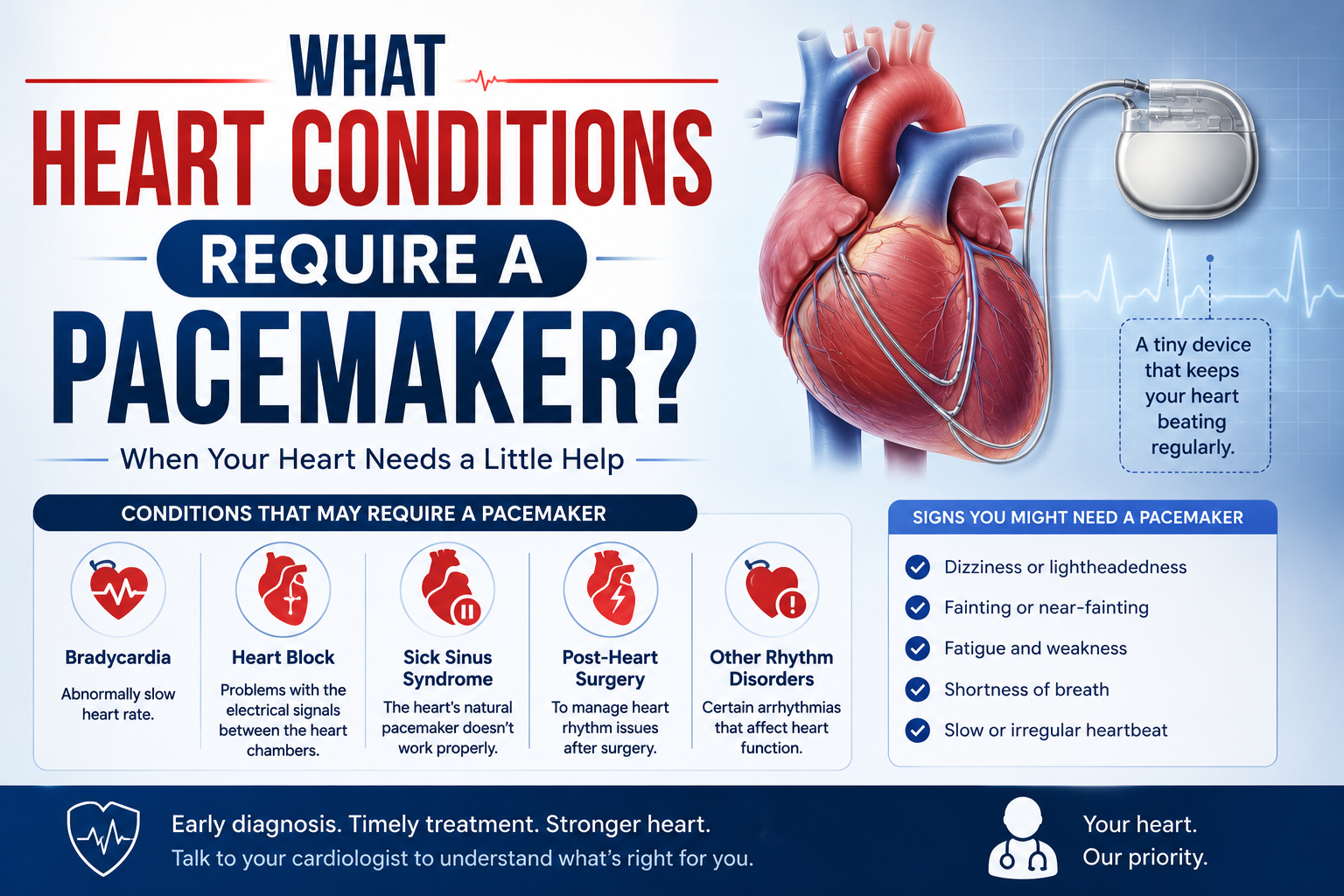
A pacemaker does not fix a weak heart muscle or clear a blocked artery. It solves one specific problem: the heart’s electrical timing has broken down, either beating too slowly, skipping beats, or losing coordination between its chambers. If you are asking what heart conditions require a pacemaker, the answer usually involves rhythm or electrical conduction problems rather than general heart weakness.
Several distinct heart conditions can cause that kind of electrical failure, and each one gets evaluated a little differently before a cardiologist recommends implanting a device. If you or someone you love has just heard the word pacemaker from a doctor, this breaks down the specific conditions behind that recommendation, what each one actually involves, and where the line is between watching and waiting versus needing the device.
The Main Conditions That Lead to a Pacemaker
| Condition | What’s Going Wrong | Why It May Need Pacing |
| Sick sinus syndrome | The heart’s natural pacemaker (the SA node) misfires or slows down | Causes unpredictable slow rates, pauses, or swings between slow and fast rhythms |
| Heart block (2nd or 3rd degree) | Electrical signals from the atria don’t reach the ventricles properly | Ventricles may beat too slowly or unpredictably on their own |
| Tachy-brady syndrome | Alternating episodes of fast and dangerously slow heart rate | Medication to control the fast rhythm often worsens the slow one |
| Symptomatic bradycardia | Resting heart rate persistently below 60, often below 40, with symptoms | Heart isn’t pumping enough blood to meet the body’s demands |
| AFib with slow ventricular response | Atrial fibrillation combined with an unusually slow beat reaching the ventricles | Common after ablation procedures or with rate-controlling medication |
| Bundle branch block (bifascicular/trifascicular) | Damage to the heart’s lower conduction pathways | Raises risk of progressing to complete heart block |
| Heart failure with dyssynchrony | The heart’s chambers contract out of sync with each other | A specialized pacemaker (CRT) can resynchronize the contraction pattern |
| Certain congenital heart conditions | Structural heart differences present from birth affecting conduction | Some patients develop heart block or sinus node dysfunction over time |
What Symptoms Usually Prompt This Conversation?
Fainting or near-fainting: Known medically as syncope or presyncope, this is one of the most common reasons doctors investigate for a pacing-related cause.
Persistent fatigue: Especially fatigue that feels disproportionate to your activity level, which can signal the heart isn’t keeping up with the body’s oxygen demands.
Dizziness or lightheadedness: Particularly episodes that come on suddenly or happen with position changes.
Shortness of breath: Especially with exertion, which can point to the heart not pumping efficiently.
A noticeably slow or irregular pulse: Something you or a doctor may pick up during a routine check.
None of these symptoms automatically mean you need a pacemaker. They’re the reason a doctor orders an ECG, a heart monitor, or further testing to see what’s actually happening electrically.
A Closer Look at the Most Common Triggers
What Actually Goes Wrong in Sick Sinus Syndrome?
The sinoatrial node is a small cluster of cells that normally sets the pace for every heartbeat. In sick sinus syndrome, this node ages, scars, or otherwise stops firing reliably. The result can be long pauses, an abnormally slow baseline rate, or a strange back-and-forth between too slow and too fast. A pacemaker essentially takes over the timing job the SA node can no longer do consistently.
Why Does Heart Block Sometimes Require Pacing and Sometimes Not?
Heart block is graded in degrees. First-degree block is usually mild and often just monitored. Second-degree block sits in a gray zone, sometimes treated, sometimes watched, depending on the specific pattern. Third-degree, or complete, heart block is a different story: the atria and ventricles are essentially no longer communicating electrically, and this almost always requires a pacemaker because the ventricles can’t be relied on to beat safely on their own.
How Is Heart Failure Different From the Other Conditions on This List?
Unlike the rhythm problems above, heart failure with dyssynchrony isn’t about the heart beating too slowly, it’s about the chambers beating out of coordination with each other. A specialized three-lead pacemaker, called cardiac resynchronization therapy, coordinates the timing between the heart’s chambers, which can meaningfully improve symptoms and outlook in the right candidates.
What Happens If a Needed Pacemaker Is Delayed?
For mild, symptom-free cases, cardiologists are often comfortable monitoring rather than rushing to surgery. But once a condition like complete heart block or symptomatic bradycardia is clearly established, delaying treatment carries real risk: fainting episodes that can lead to falls or injury, worsening fatigue and exercise intolerance, and in more severe cases, dangerously low heart rates that can be life-threatening. This is part of why testing and a clear diagnosis matter more than guessing based on symptoms alone.
Who Tends to Develop These Conditions?
- Older adults, since age-related scarring of the heart’s conduction system is the single biggest risk factor
- People with a history of heart attack or heart surgery, which can damage conduction pathways
- People on certain medications, including some beta blockers and calcium channel blockers, that can slow the heart further
- People with congenital heart defects, some of whom develop conduction problems later in life
- Patients who have undergone catheter ablation for atrial fibrillation
- People with a family history of inherited conduction disorders
Not All Pacemakers Are the Same: A Quick Comparison
| Pacemaker Type | Typically Used For |
| Single-chamber | Simpler rhythm problems affecting one chamber, often the ventricle |
| Dual-chamber | Conditions like heart block or sick sinus syndrome needing coordinated atrial and ventricular pacing |
| Biventricular (CRT) | Heart failure with dyssynchrony between the heart’s pumping chambers |
| Leadless pacemaker | Certain single-chamber pacing needs, implanted directly in the heart without wires |
What Doesn’t Usually Require a Pacemaker?
It’s worth knowing what falls outside this list too. A slow heart rate alone, especially in fit, healthy people or trained athletes, is often completely normal and does not need treatment. Mild, first-degree heart block found incidentally on an ECG is frequently just monitored. Occasional, brief episodes of dizziness with an otherwise normal heart rhythm usually point to something other than a pacing problem, such as dehydration or a drop in blood pressure. A cardiologist’s job is largely about telling these lower-risk patterns apart from the ones that genuinely need device therapy.
How Do Cardiologists Actually Decide?
The decision generally comes down to three things working together: whether there’s a clear structural or electrical problem on testing, whether that problem lines up with the symptoms you’re having, and whether other reversible causes, like medication side effects or thyroid issues, have been ruled out first. Professional cardiology guidelines describe some situations, like complete heart block with symptoms, as near-automatic indications, while others, like mild sinus node dysfunction, are judged case by case.
This is why two people with what looks like a ‘slow heart rate’ on paper can get very different recommendations. Context and testing matter as much as the raw numbers.
When Does This Become an Emergency Rather Than a Planned Procedure?
Seek emergency care for fainting with no clear cause, chest pain, a heart rate that feels dangerously slow along with confusion or severe weakness, or a known heart block diagnosis with new or worsening symptoms. In these situations, a temporary pacemaker can sometimes be placed urgently while the team evaluates whether a permanent device is needed.
Where This Leaves You
Needing a pacemaker isn’t tied to one single diagnosis. It’s tied to a pattern: the heart’s electrical system failing to keep a safe, reliable rhythm, whether that’s from sinus node dysfunction, heart block, certain arrhythmias, or heart failure with poor coordination between chambers. If you’ve been told you might need one, the most useful next step is understanding exactly which of these categories applies to you, since that shapes both the type of device recommended and how urgently it’s needed.
Questions People Often Ask After a Pacemaker Recommendation
Does a slow heart rate always mean I need a pacemaker?
No. Many people, especially athletes, have naturally slow heart rates without any underlying problem. A pacemaker is considered when a slow rate causes symptoms or reflects a specific electrical disorder.
Can medication cause the kind of bradycardia that leads to a pacemaker?
Yes, certain heart medications can slow the heart rate significantly. Doctors typically try adjusting or stopping the medication first, when possible, before considering a pacemaker.
Is heart block always permanent once it’s diagnosed?
Not always. Some causes, like certain infections or temporary medication effects, can resolve. Complete heart block, however, is usually persistent and typically requires a pacemaker.
Can atrial fibrillation alone require a pacemaker?
AFib on its own usually doesn’t require a pacemaker, but a pacemaker may become necessary if AFib is combined with a dangerously slow heart rate or follows certain ablation procedures.
Will I feel different once a pacemaker is treating one of these conditions?
Many people notice reduced fatigue, fewer dizzy spells, and more stable energy levels once the device corrects the underlying rhythm problem, though the exact improvement depends on the condition being treated.
How is this diagnosed in the first place?
Diagnosis typically involves an ECG, an extended heart rhythm monitor worn for days or weeks, and sometimes additional testing to rule out other causes of symptoms.
Are these conditions preventable?
Some risk factors, like age-related conduction system wear, aren’t preventable, but managing heart disease risk factors overall, such as blood pressure and cholesterol, supports better heart health broadly.
What should I ask my cardiologist if a pacemaker is being discussed?
It’s reasonable to ask exactly which condition is driving the recommendation, whether it’s urgent or something you can take time to consider, and what type of device is being proposed and why.