

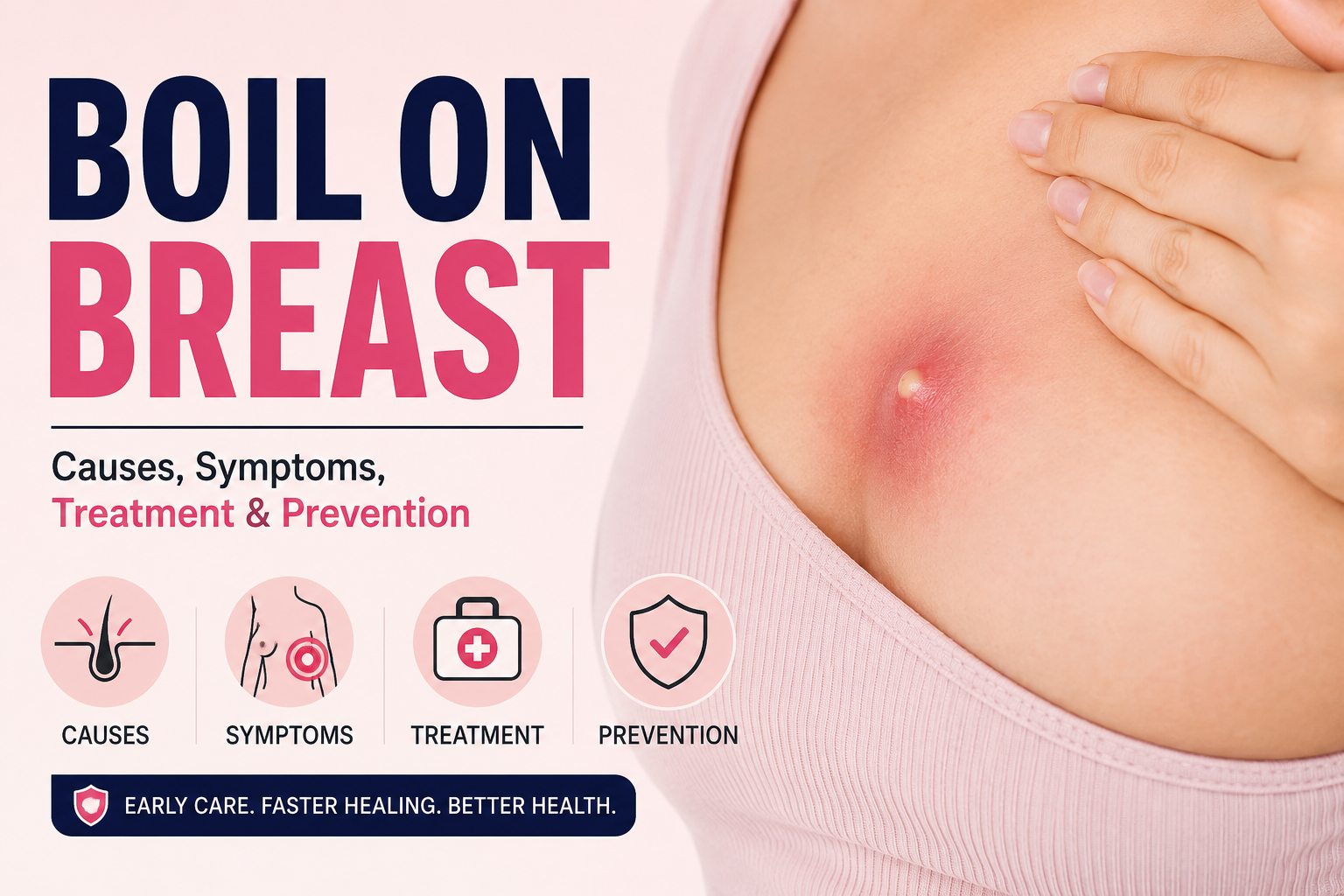
How to recognize a breast-skin boil, care for a small one safely, distinguish it from deeper breast conditions, and know when medical drainage may be needed
| Quick fact | What to know |
| What it is | A painful, pus-filled bacterial infection involving a hair follicle and nearby skin. |
| Common triggers | Sweat, friction, shaving nicks, ingrown hairs, clogged follicles, and small breaks in the skin. |
| Typical appearance | A firm, tender red, purple, or darker bump that may develop a white or yellow center. |
| Basic home care | Warm moist compresses, gentle cleansing, clean dressings, and careful hand hygiene. |
| Do not do this | Do not squeeze, pierce, or cut the lump at home. |
| See a clinician | If it is rapidly enlarging, very painful, recurrent, not improving, or accompanied by fever or spreading redness. |
| Key takeaways
Most small breast-skin boils begin in a hair follicle and may drain within one to two weeks. Warm compresses can support natural drainage, but squeezing can push infection deeper. A lump beneath the breast tissue, diffuse breast redness, fever during breastfeeding, recurrent nodules, or a persistent mass may represent something other than a simple boil and should be examined. |
A boil on breast skin is usually a localized infection that starts around a hair follicle. It often begins as a sore, firm bump and becomes more painful as pus collects under the skin. Sweat and rubbing beneath a bra band can make the area especially uncomfortable.
The breast also contains glands, ducts, fat, connective tissue, and lymphatic tissue, so every painful lump should not automatically be labeled a boil. The clues that favor a surface infection are tenderness in the skin, warmth, a visible raised bump, and a center that begins to soften or drain.
What Is a Breast Boil?
A boil, also called a furuncle, is a deeper form of folliculitis. Bacteria, most often Staphylococcus aureus, enter a damaged or blocked hair follicle and cause inflammation in the surrounding skin. White blood cells, bacteria, and damaged tissue collect as pus. Several connected boils are called a carbuncle.
Breast boils often develop on the outer skin, beneath the breast fold, near the bra line, or around areas that are shaved. They can occur in people of any sex. A boil on the skin is different from a deeper breast abscess, although a surface infection can sometimes become larger or extend into surrounding tissue.
What Does It Look and Feel Like?
Early on, the area may feel itchy, sore, or bruised before a distinct lump appears. The bump commonly becomes warm, swollen, and increasingly tender. On lighter skin it may look pink or red; on darker skin it may appear purple, deep brown, gray-red, or simply darker than nearby skin. A white or yellow point may appear when the boil is close to draining.
| Condition | Common clues | Why evaluation may be needed |
| Boil | Tender raised skin bump, warmth, pus-filled center, pain that eases after drainage | May need drainage or antibiotics if large, recurrent, or spreading |
| Pimple or folliculitis | Smaller superficial bumps centered on individual follicles | Persistent clusters may need a different treatment |
| Epidermoid cyst | Slow-growing round lump, sometimes with a central pore; may become inflamed | An infected cyst can resemble a boil |
| Breast abscess or mastitis | Deeper breast pain, broad redness, swelling, fever, or breastfeeding symptoms | Often needs prompt medical treatment and imaging |
| Hidradenitis suppurativa | Repeated painful nodules under breasts, armpits, or groin with tunnels or scars | Requires long-term dermatology care |
Why Breast Boils Develop
The skin beneath and around the breasts is vulnerable to moisture and friction. Tight bras, sweaty workout clothing, skin-to-skin rubbing, shaving, waxing, and ingrown hairs can create tiny openings where bacteria enter. Reusing a dull razor or sharing towels can increase exposure.
Shaving-related irritation and infected follicles can overlap. This Conway Behavioral Health guide to strawberry legs, ingrown hairs, and folliculitis explains how clogged or inflamed follicles can progress from small bumps to tender, pus-filled lesions. Similar follicle irritation can occur beneath the breast after hair removal or repeated rubbing.
Diabetes, obesity, smoking, eczema, immune-suppressing medicines, poor wound healing, and previous staph or MRSA infections can increase the risk. Recurrent boils do not automatically mean a vitamin deficiency, but repeated infections deserve a broader review of blood sugar, immune health, skin conditions, and possible bacterial colonization.
For a deeper discussion of repeated infections, see what your body may be lacking when boils keep returning. The useful distinction is between one isolated boil and a pattern that keeps returning, because recurring lesions may justify a wound culture, diabetes screening, or evaluation for hidradenitis suppurativa.
How to Treat a Small Boil at Home
- Apply a clean, warm, moist compress for 10 to 15 minutes, three or four times daily. The cloth should feel comfortably warm, not hot enough to burn.
- Wash the surrounding skin gently with soap and water. Pat the fold completely dry afterward.
- If the boil opens, allow it to drain without pressure. Cover it with clean gauze and change the dressing whenever it becomes wet or soiled.
- Wash your hands before and after touching the area, and wash towels, bras, bedding, and workout clothing that contact drainage.
- Use an over-the-counter pain reliever only if it is safe with your health conditions and other medicines.
The National Library of Medicine advises warm, moist compresses and specifically warns against squeezing or cutting a boil at home. Review the MedlinePlus boil care guidance for information about drainage, dressings, cultures, and signs that require professional care.
| Do not pop or lance it
Pressure can drive bacteria into deeper tissue, spread infection across the breast skin, increase scarring, and make a culture less useful. Large or deep boils are drained with sterile instruments and pain control by a healthcare professional. |
When to See a Doctor
- The lump is getting larger, more painful, or is not starting to improve after several days of home care.
- It has not healed within about one to two weeks.
- You have fever, chills, fatigue, red streaks, rapidly spreading redness, or increasing warmth.
- The lump is close to the nipple, feels deep in the breast, or is accompanied by nipple discharge or broader breast swelling.
- You are breastfeeding and have fever, worsening breast pain, or a hot red area.
- Boil-like lumps repeatedly appear under the breasts, armpits, or groin.
- You have diabetes, a weakened immune system, or a history of MRSA.
A clinician may examine the lump, use ultrasound if the infection seems deep, collect drainage for culture, or perform incision and drainage. Antibiotics are not required for every small boil, but they may be prescribed when there is cellulitis, fever, multiple lesions, immune suppression, recurrence, or concern about resistant bacteria.
The CDC notes that MRSA skin infections can look red, swollen, painful, warm, and full of pus, and appearance alone cannot confirm the organism. Read the CDC MRSA basics to understand why a culture may be needed and why an antibiotic should be selected by a healthcare professional rather than borrowed or reused.
Could It Be Breast Cancer?
A typical boil is a painful skin lesion with warmth, swelling, and pus. Breast cancer more often causes a persistent mass or structural skin change rather than a boil that comes to a head and drains. Still, a new breast lump should be checked when the diagnosis is uncertain, especially if it remains after the skin heals.
Seek prompt evaluation for a hard or fixed lump, nipple inversion, bloody discharge, dimpling, orange-peel skin, unexplained swelling of most of the breast, or redness that does not respond as expected to infection treatment. These signs do not prove cancer, but they should not be managed indefinitely as a boil.
How to Reduce the Chance of Another Boil
- Shower after exercise and change out of sweaty bras or shirts promptly.
- Dry the skin fold completely and choose breathable, properly fitted bras that reduce rubbing.
- Use clean razors, shave with lubrication, and replace dull blades.
- Do not share towels, razors, clothing, or dressings while a boil is active.
- Keep diabetes and other chronic conditions well managed.
- Ask for evaluation if lesions recur, scar, form tunnels, or repeatedly affect the same skin folds.
Frequently Asked Questions
How long does a breast boil take to heal?
A small boil often drains and improves within one to two weeks. Healing may take longer if it is deep, repeatedly irritated, or medically drained.
Is a breast boil contagious?
The lump itself is not transmitted like a cold, but the bacteria in drainage can spread through skin contact, towels, razors, clothing, or dressings.
Can I use antibiotic cream?
A boil is deeper than a surface scrape, so a cream may not reach the main infection. Use only products recommended by a clinician and do not let topical treatment delay evaluation of a worsening lump.
Why do I keep getting boils under my breasts?
Repeated friction, sweating, diabetes, staph colonization, smoking, obesity, immune problems, or hidradenitis suppurativa may contribute. Recurring lesions need an examination rather than repeated self-treatment.
Can breastfeeding cause a boil?
Breastfeeding does not directly cause a hair-follicle boil, but milk stasis, mastitis, and breast abscess can create painful red lumps. Fever or deep breast pain during breastfeeding needs prompt care.
Bottom Line
A boil on breast skin is usually a tender bacterial infection centered on a hair follicle. Warm compresses, cleanliness, dry dressings, and avoiding pressure are appropriate first steps for a small uncomplicated lesion. Most importantly, never squeeze or cut it open yourself.
Arrange medical care when the lump is large, deep, recurrent, worsening, or accompanied by fever or spreading redness. A persistent breast mass, widespread breast changes, or symptoms during breastfeeding should be evaluated as a possible breast condition rather than assumed to be a simple skin boil.
| Medical disclaimer
This article is for general education and does not diagnose a breast lump or skin infection. Contact a qualified healthcare professional for persistent, recurrent, or worsening symptoms. Seek urgent care for rapidly spreading redness, severe pain, fever with illness, faintness, or other signs of a serious infection. |